
Hebrew and Gregorian Years
Cite this page
Israel in Time (2027), CAL-003, p. 48, israelnowlej.com/cal-003
Short address: israelnowlej.com/cal-003
Text of this page
ISRAEL IN TIME CALENDARS
Reference Hebrew and Gregorian Years
The next ten years of the Hebrew calendar, mapped onto the Gregorian one.
The Hebrew year starts in the autumn, so each Hebrew year spans two Gregorian years. This chart maps the next eleven Hebrew years onto the Gregorian calendar. A common year has 353, 354 or 355 days, and a leap year, with its extra month of Adar, has 383, 384 or 385. Every holiday and memorial day begins at sundown on the evening before the date shown.
HEBREW YEAR BEGINS (1 TISHREI) DAYS KIND PASSOVER IN SPRING
5787 Sep 12, 2026 385 Leap year, 13 months Apr 22, 2027
5788 Oct 2, 2027 355 Common year, 12 months Apr 11, 2028
5789 Sep 21, 2028 354 Common year, 12 months Mar 31, 2029
5790 Sep 10, 2029 383 Leap year, 13 months Apr 18, 2030
5791 Sep 28, 2030 355 Common year, 12 months Apr 8, 2031
5792 Sep 18, 2031 354 Common year, 12 months Mar 27, 2032
5793 Sep 6, 2032 383 Leap year, 13 months Apr 14, 2033
5794 Sep 24, 2033 355 Common year, 12 months Apr 4, 2034
5795 Sep 14, 2034 385 Leap year, 13 months Apr 24, 2035
5796 Oct 4, 2035 354 Common year, 12 months Apr 12, 2036
5797 Sep 22, 2036 353 Common year, 12 months Mar 31, 2037
When the new year falls
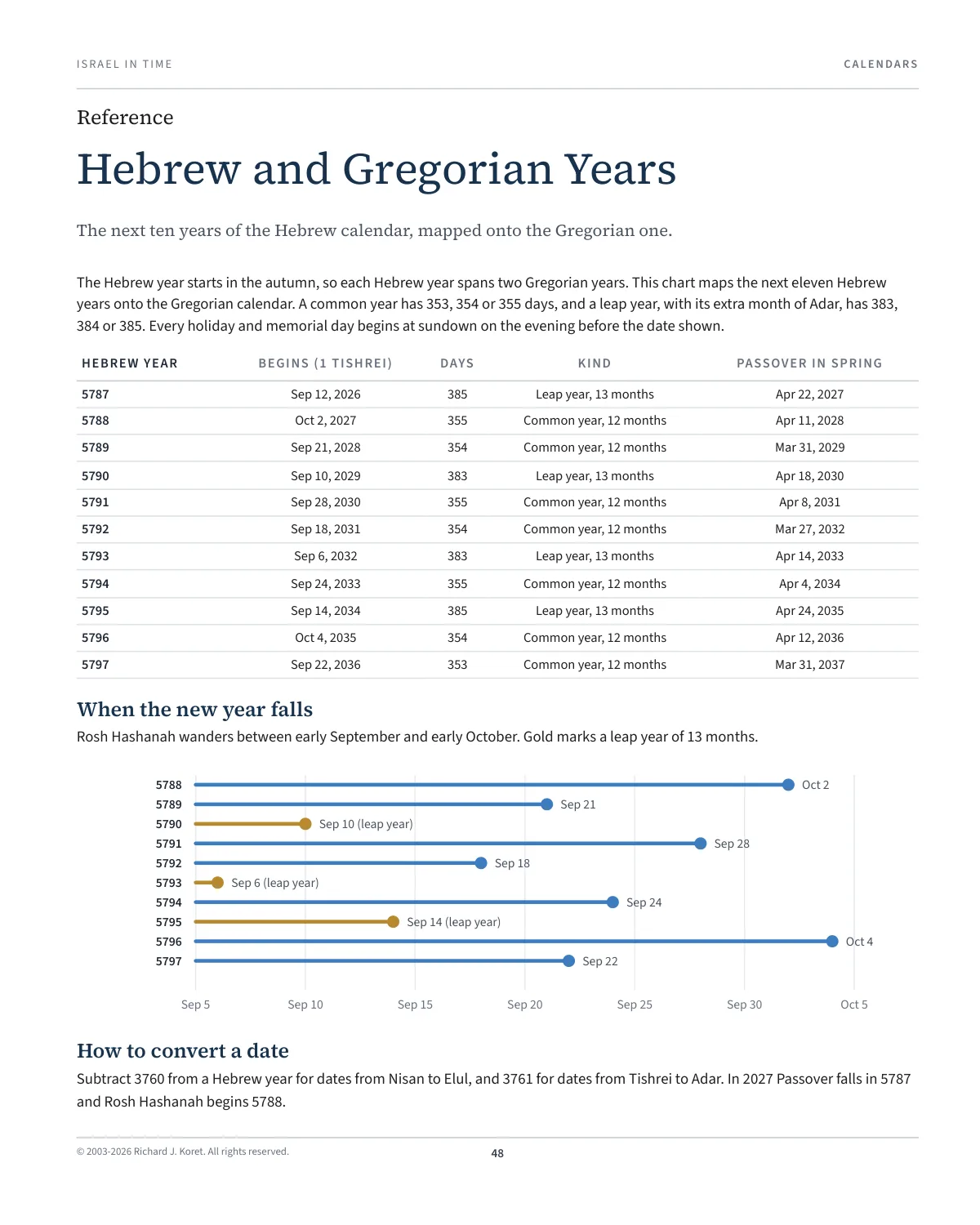
Rosh Hashanah wanders between early September and early October. Gold marks a leap year of 13 months.
Sep 5 Sep 10 Sep 15 Sep 20 Sep 25 Sep 30 Oct 5
5788 Oct 2
5789 Sep 21
5790 Sep 10 (leap year)
5791 Sep 28
5792 Sep 18
5793 Sep 6 (leap year)
5794 Sep 24
5795 Sep 14 (leap year)
5796 Oct 4
5797 Sep 22
How to convert a date
Subtract 3760 from a Hebrew year for dates from Nisan to Elul, and 3761 for dates from Tishrei to Adar. In 2027 Passover falls in 5787 and Rosh Hashanah begins 5788.
Hebrew calendar dates were computed from the calendar rules. The page appears in the book Israel in Time, page 48.