
Judea under Herod and Rome
Cite this page
Israel NOWlej (2027), MAP-006, pp. 14 to 15, israelnowlej.com/map-006
Short address: israelnowlej.com/map-006
Text of this page
MAP 6
M E D I T E R R A N E A N
S E A
S Y R I A
L E B A N O N
J O R D A N
DEAD SEA DEAD SEA
Jerusalem Jerusalem
Caesarea Caesarea
Sebaste Sebaste
Gaza Gaza
Ashdod Ashdod
Lydda Lydda
Beersheba Beersheba
Bethlehem Bethlehem
Nazareth Nazareth
Sepphoris Sepphoris
Tiberias Tiberias
Capernaum Capernaum
Jericho Jericho
Herodium Herodium
Masada Masada
Dora Dora
Ashkelon Ashkelon
Skitopolis Skitopolis
Abila Abila
Kanata Kanata
Philadelphia Philadelphia
J U D E A
S A M A R I A
G A L I L E E
P E R E A
I D U M E A
Agrippa II
then Syria
SEA OF GALILEE SEA OF GALILEE
L E G E N D
Herod, then Judea
Herod, then Agrippa II
Modern Israel
City
Herodian site
Free city, not under Herod
N
50 km
31 mi
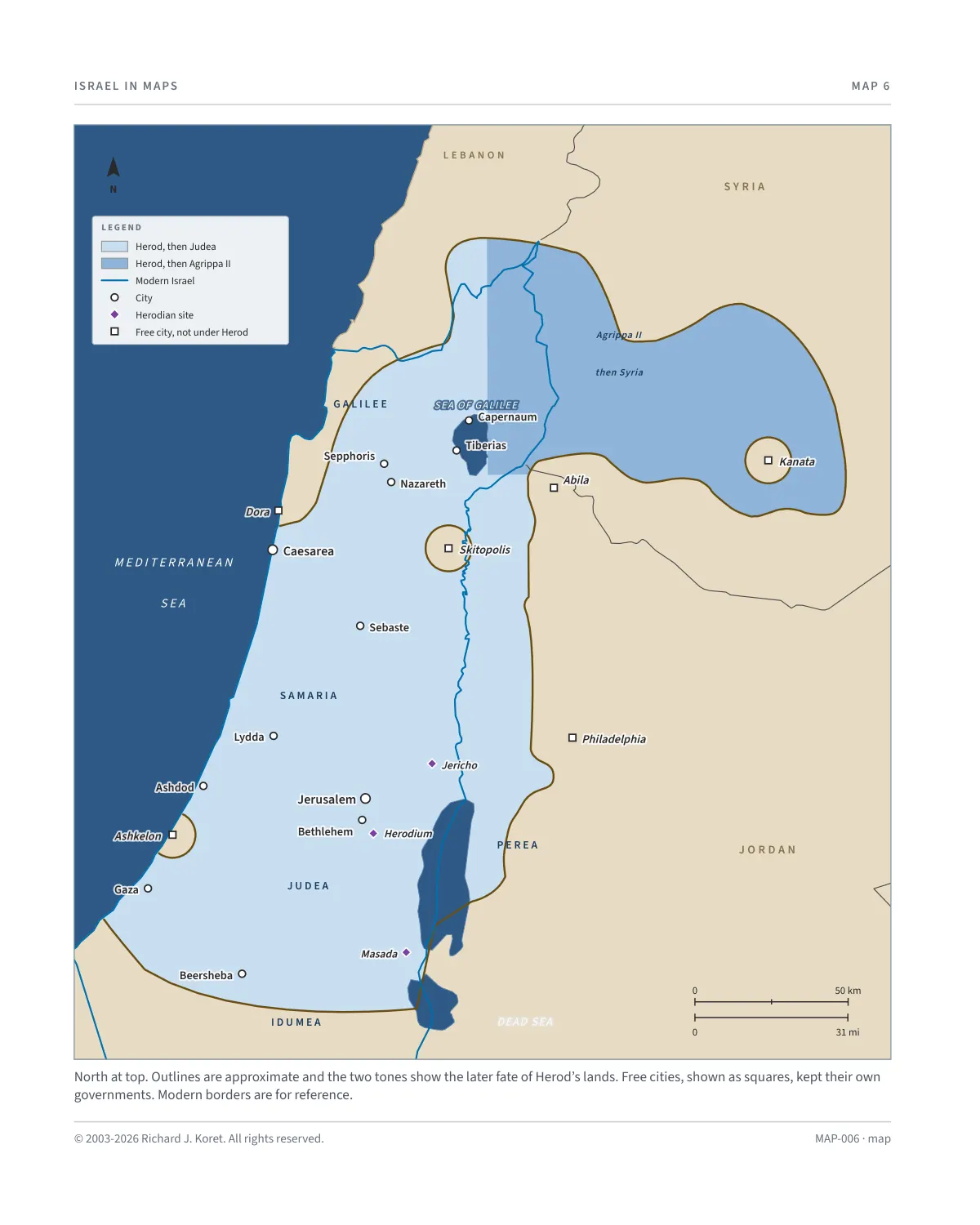
North at top. Outlines are approximate and the two tones show the later fate of Herod’s lands. Free cities, shown as squares, kept their own governments. Modern borders are for reference.
MAP-006 · map
HISTORICAL MAPS
MAP 6 Judea under Herod and Rome
40 BCE to about 100 CE, with the border of modern Israel for reference
King Herod (“Herod the Great”) ruled Judea under Roman authority from 40 to 4 BCE. Son of the Idumean Antipater, he was appointed after Rome’s conquest of the Hasmonean kingdom (Map 5). Unpopular with many Jews for his Roman ties, he held power through skill and loyalty to Rome. His reign brought stability and great building, including the rebuilding of the Second Temple and the port city of Caesarea.
In 30 BCE Augustus enlarged the kingdom to include Judea, Samaria, Galilee, Idumea and lands beyond the Jordan such as the Golan. Jesus was born in these years, before Herod died in 4 BCE.
In 6 CE Rome removed Herod’s son Archelaus and ruled Judea directly through prefects, among them Pontius Pilate (26 to 36 CE). Jesus taught in Galilee and was crucified in Jerusalem around 30 CE.
The Great Revolt (66 to 73 CE) ended with the destruction of the Temple in 70. Circa 100 CE the darker area was the Roman province of Judea, a vital crossroads of commerce, culture and strategic control. After the Bar Kokhba revolt (132 to 135 CE) Hadrian renamed Jerusalem Aelia Capitolina and the province Syria Palaestina, to erase the Jewish ties to the land.
PLACES
Jerusalem Capital. Herod rebuilt the Second Temple. Destroyed in 70 CE, yet still the center of Jewish life.
Bethlehem Symbol of Jewish and Christian heritage. Birthplace of King David and, in Christian tradition, of Jesus.
Nazareth, Capernaum Nazareth, the Galilee home of Jesus. Capernaum, a fishing village and key site of his ministry.
Sepphoris, Tiberias Sepphoris, a hub of Greco-Roman commerce. Tiberias, founded about 20 CE, a center of Jewish learning.
Caesarea Built on Strato’s Tower, given by Augustus in 30 BCE. Roman capital, famed for its harbor.
Sebaste Samaria rebuilt by Herod and renamed for Augustus (Greek Sebastos). Modern Sebastia.
Lydda, Ashdod Lydda (Lod), a coastal plain town, now by Israel’s airport. Ashdod (Azotus), a trade port.
Gaza, Beersheba Gaza joined Herod’s kingdom in 30 BCE. Beersheba was Rome’s southernmost city, on desert trade routes.
Jericho, Herodium, Masada
Herod’s winter palace, his fortress-tomb near Bethlehem, and the desert fortress that fell to Rome in 73 CE.
Free cities Dora, Ashkelon, Skitopolis and the Decapolis cities Abila, Kanata and Philadelphia governed themselves.
After 4 BCE Archelaus (Judea, Samaria, Idumea), Antipas (Galilee, Perea), Philip (north-east, later Agrippa II).
MAP006 Open on your phone $.- ’)*2’ % *(„( +›
Corrections: none recorded. This is the current version. The 2027 print edition copy is at israelnowlej.com/2027/map-006.