
Wildlife
Cite this page
Israel NOWlej (2027), WLD-00, pp. 164 to 166, israelnowlej.com/wld-00
Short address: israelnowlej.com/wld-00
In this section
- WLD-01 Nubian ibexp. 164
- WLD-02 Rock hyraxp. 164
- WLD-03 Mountain gazellep. 164
- WLD-04 Golden jackalp. 165
- WLD-05 Arabian oryxp. 165
- WLD-06 Wild assp. 165
- WLD-07 Arabian leopardp. 166
- WLD-08 Striped hyenap. 166
- WLD-09 Fire salamanderp. 166
Text of this page
FLORA AND FAUNA
Wildlife
Israel's animals come from Europe, Africa, and Asia, and several nearly disappeared before being brought back by reintroduction programs. Some are common sights and others are rarely seen, but all of them live within a short drive of the country's cities.
Nubian ibex Sure-footed on the cliffs
יעלCapra nubiana
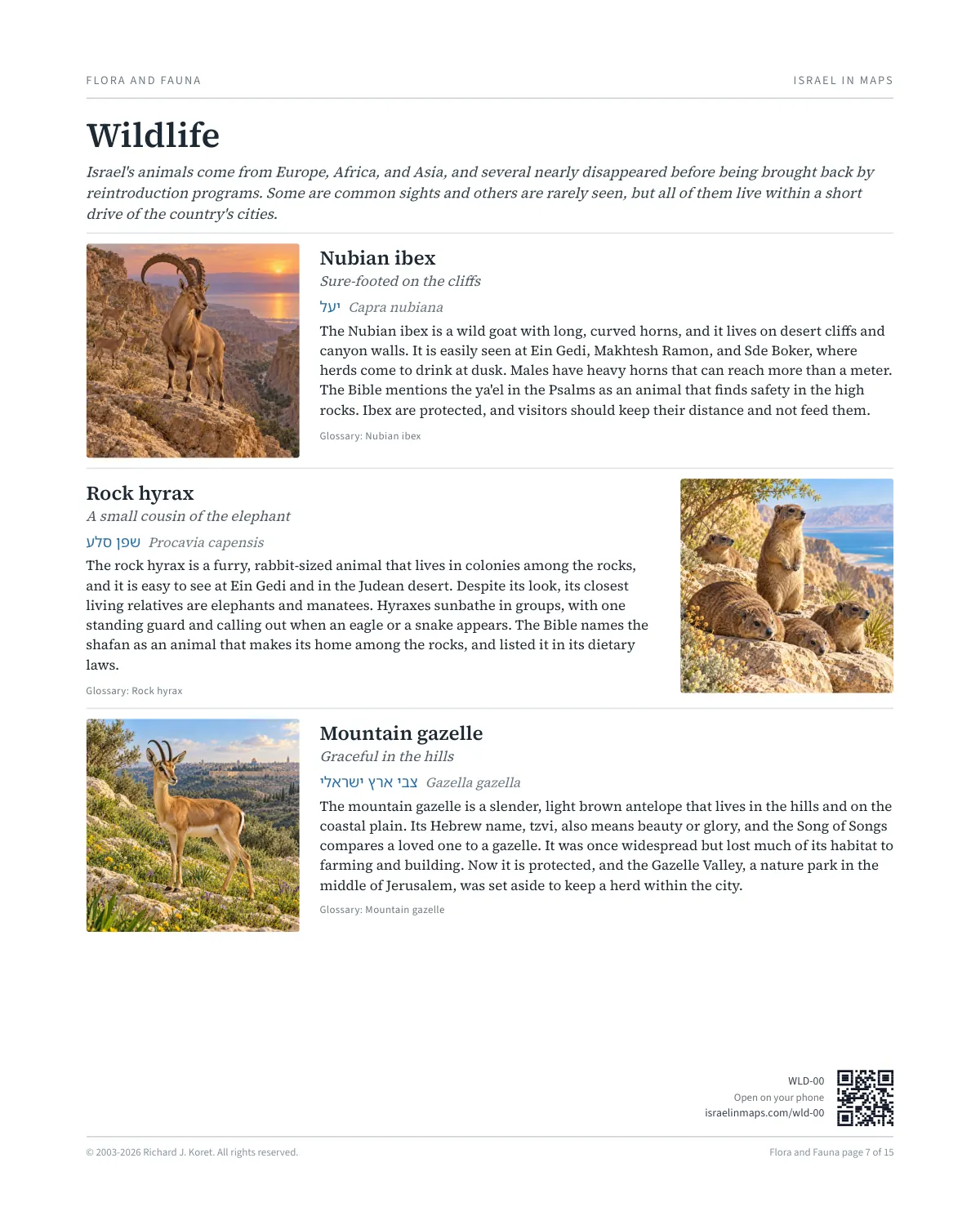
The Nubian ibex is a wild goat with long, curved horns, and it lives on desert cliffs and canyon walls. It is easily seen at Ein Gedi, Makhtesh Ramon, and Sde Boker, where herds come to drink at dusk. Males have heavy horns that can reach more than a meter. The Bible mentions the ya'el in the Psalms as an animal that finds safety in the high rocks. Ibex are protected, and visitors should keep their distance and not feed them.
Glossary: Nubian ibex
Rock hyrax A small cousin of the elephant
שפן סלעProcavia capensis
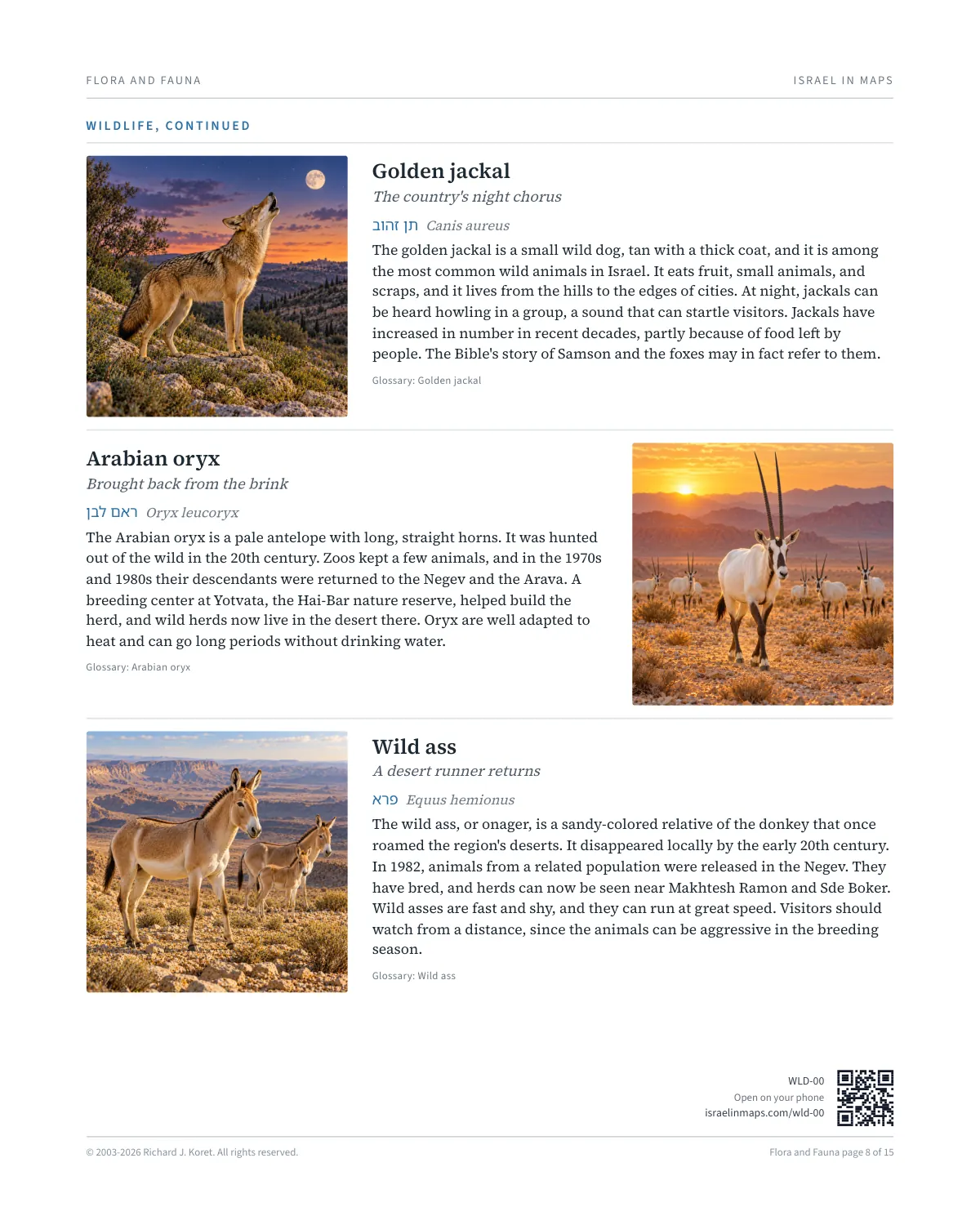
The rock hyrax is a furry, rabbit-sized animal that lives in colonies among the rocks, and it is easy to see at Ein Gedi and in the Judean desert. Despite its look, its closest living relatives are elephants and manatees. Hyraxes sunbathe in groups, with one standing guard and calling out when an eagle or a snake appears. The Bible names the shafan as an animal that makes its home among the rocks, and listed it in its dietary laws.
Glossary: Rock hyrax
Mountain gazelle Graceful in the hills
צבי ארץ ישראליGazella gazella
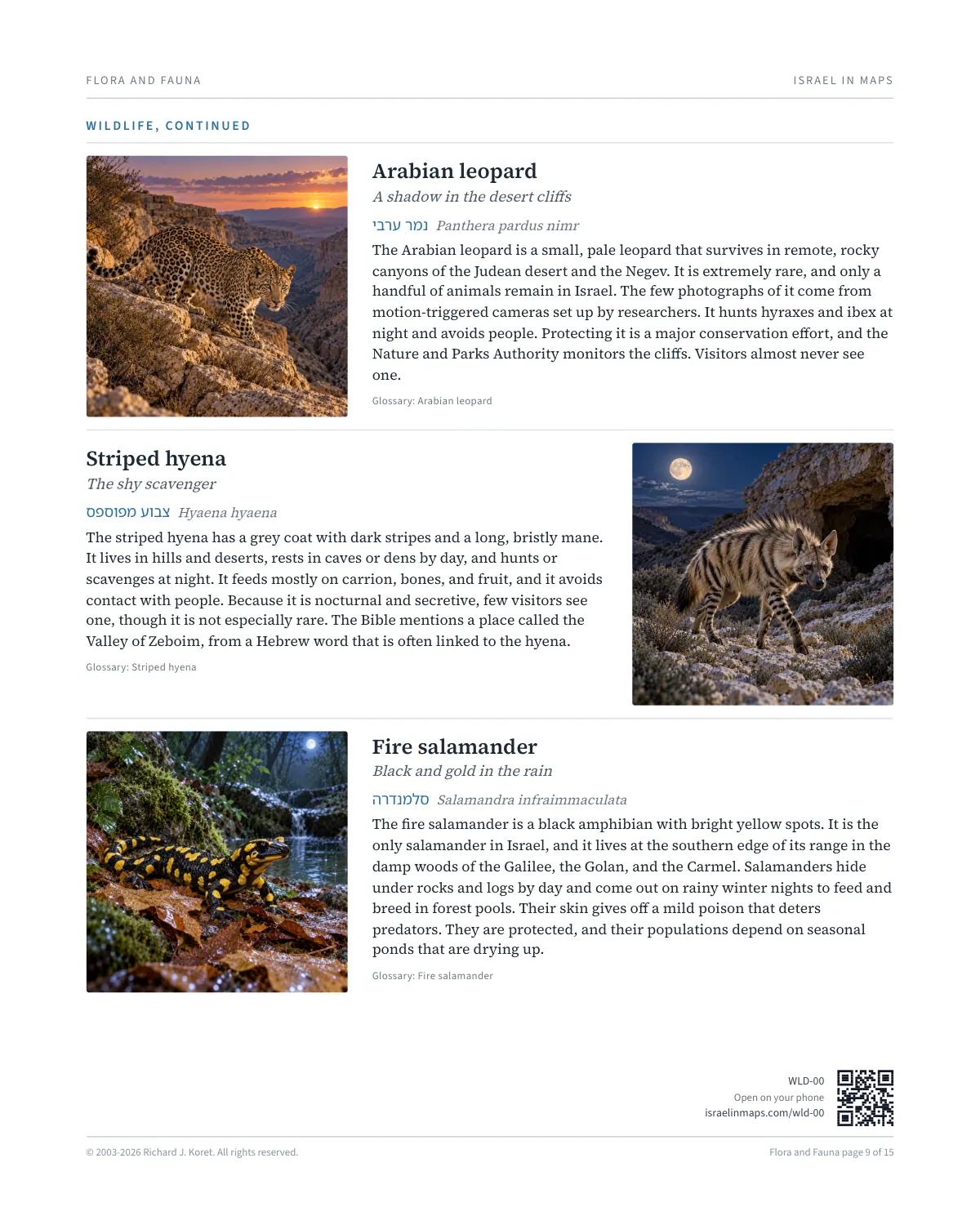
The mountain gazelle is a slender, light brown antelope that lives in the hills and on the coastal plain. Its Hebrew name, tzvi, also means beauty or glory, and the Song of Songs compares a loved one to a gazelle. It was once widespread but lost much of its habitat to farming and building. Now it is protected, and the Gazelle Valley, a nature park in the middle of Jerusalem, was set aside to keep a herd within the city.
Glossary: Mountain gazelle
Flora and Fauna page 7 of 15
WLD00 Open on your phone $.- ’)*2’ % *(„2’ ›
FLORA AND FAUNA
W I L D L I F E , CO N T I N U E D
Golden jackal
The country's night chorus
תן זהובCanis aureus
The golden jackal is a small wild dog, tan with a thick coat, and it is among the most common wild animals in Israel. It eats fruit, small animals, and scraps, and it lives from the hills to the edges of cities. At night, jackals can be heard howling in a group, a sound that can startle visitors. Jackals have increased in number in recent decades, partly because of food left by people. The Bible's story of Samson and the foxes may in fact refer to them.
Glossary: Golden jackal
Arabian oryx
Brought back from the brink
ראם לבןOryx leucoryx
The Arabian oryx is a pale antelope with long, straight horns. It was hunted out of the wild in the 20th century. Zoos kept a few animals, and in the 1970s and 1980s their descendants were returned to the Negev and the Arava. A breeding center at Yotvata, the Hai-Bar nature reserve, helped build the herd, and wild herds now live in the desert there. Oryx are well adapted to heat and can go long periods without drinking water.
Glossary: Arabian oryx
Wild ass
A desert runner returns
פראEquus hemionus
The wild ass, or onager, is a sandy-colored relative of the donkey that once roamed the region's deserts. It disappeared locally by the early 20th century. In 1982, animals from a related population were released in the Negev. They have bred, and herds can now be seen near Makhtesh Ramon and Sde Boker. Wild asses are fast and shy, and they can run at great speed. Visitors should watch from a distance, since the animals can be aggressive in the breeding season.
Glossary: Wild ass
Flora and Fauna page 8 of 15
WLD00 Open on your phone $.- ’)*2’ % *(„2’ ›
FLORA AND FAUNA
W I L D L I F E , CO N T I N U E D
Arabian leopard
A shadow in the desert cliffs
נמר ערביPanthera pardus nimr
The Arabian leopard is a small, pale leopard that survives in remote, rocky canyons of the Judean desert and the Negev. It is extremely rare, and only a handful of animals remain in Israel. The few photographs of it come from motion-triggered cameras set up by researchers. It hunts hyraxes and ibex at night and avoids people. Protecting it is a major conservation effort, and the Nature and Parks Authority monitors the cliffs. Visitors almost never see one.
Glossary: Arabian leopard
Striped hyena
The shy scavenger
צבוע מפוספסHyaena hyaena
The striped hyena has a grey coat with dark stripes and a long, bristly mane. It lives in hills and deserts, rests in caves or dens by day, and hunts or scavenges at night. It feeds mostly on carrion, bones, and fruit, and it avoids contact with people. Because it is nocturnal and secretive, few visitors see one, though it is not especially rare. The Bible mentions a place called the Valley of Zeboim, from a Hebrew word that is often linked to the hyena.
Glossary: Striped hyena
Fire salamander
Black and gold in the rain
סלמנדרהSalamandra infraimmaculata
The fire salamander is a black amphibian with bright yellow spots. It is the only salamander in Israel, and it lives at the southern edge of its range in the damp woods of the Galilee, the Golan, and the Carmel. Salamanders hide under rocks and logs by day and come out on rainy winter nights to feed and breed in forest pools. Their skin gives off a mild poison that deters predators. They are protected, and their populations depend on seasonal ponds that are drying up.
Glossary: Fire salamander
Flora and Fauna page 9 of 15
WLD00 Open on your phone $.- ’)*2’ % *(„2’ ›
Corrections: none recorded. This is the current version. The 2027 print edition copy is at israelnowlej.com/2027/wld-00.