
Trees of Israel
Cite this page
Israel NOWlej (2027), TRE-00, pp. 159 to 161, israelnowlej.com/tre-00
Short address: israelnowlej.com/tre-00
In this section
- TRE-01 Carobp. 159
- TRE-02 Olivep. 159
- TRE-03 Tabor oakp. 159
- TRE-04 Atlantic terebinthp. 160
- TRE-05 Date palmp. 160
- TRE-06 Tamariskp. 160
- TRE-07 Aleppo pinep. 161
- TRE-08 Acaciap. 161
- TRE-09 Eucalyptusp. 161
Text of this page
FLORA AND FAUNA
Trees of Israel
Israel's trees range from ancient olives and great oaks of the north to flat-topped acacias in the southern desert. Some are native, some were planted by early settlers, and some appear in the Bible. Rainfall shapes the pattern. The wetter north and the hills support woods of oak, carob, and terebinth, the dry south holds only hardy trees that can reach deep water, and irrigation has made palm groves possible in the hot valleys. In the 20th century, foresters planted pines and eucalyptus on bare hills, and today more native species are being used again. Many old trees are treated as landmarks, and some are protected by law. These nine are the ones a visitor is most likely to notice.
Carob The tree of the sweet pod
חרובCeratonia siliqua
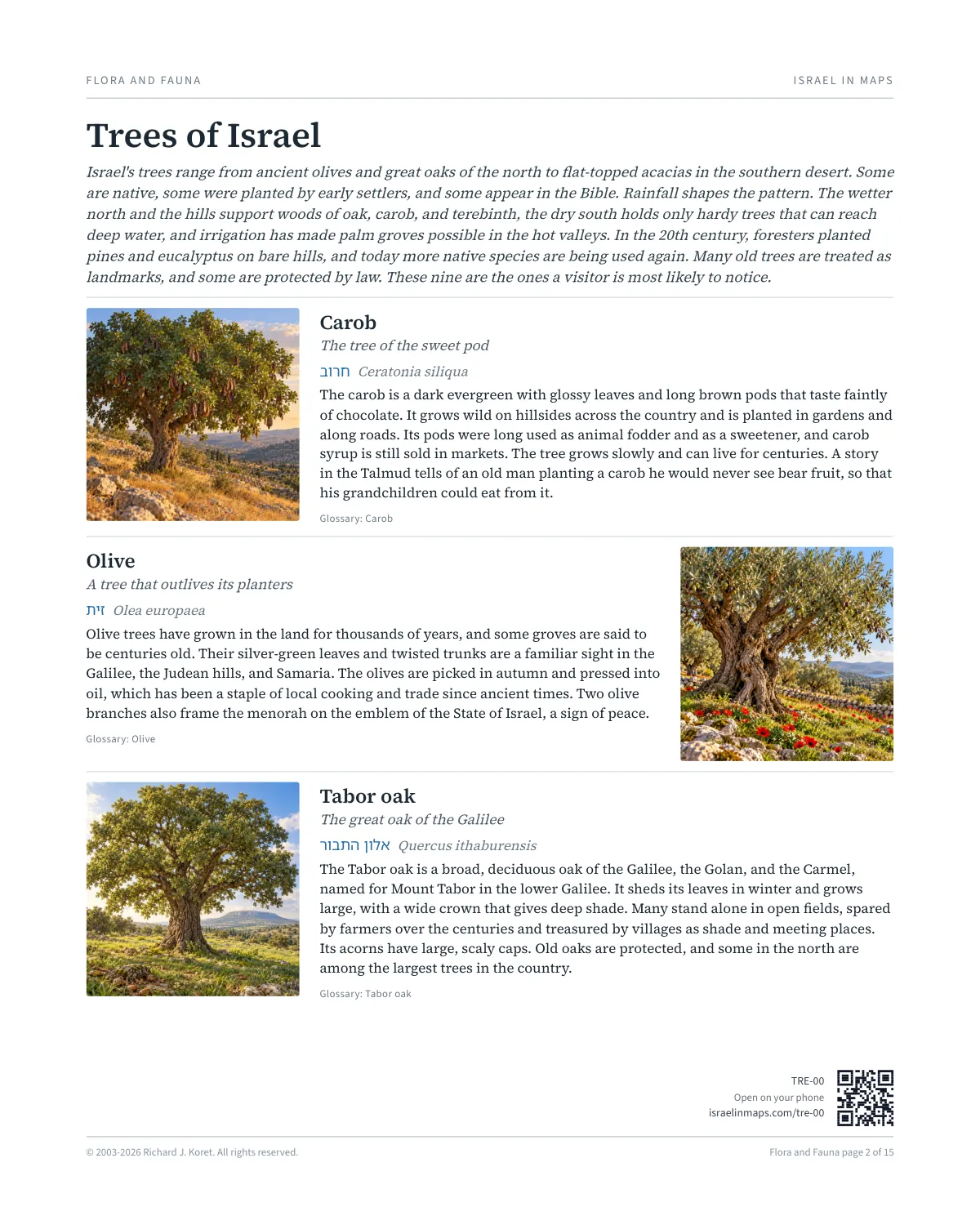
The carob is a dark evergreen with glossy leaves and long brown pods that taste faintly of chocolate. It grows wild on hillsides across the country and is planted in gardens and along roads. Its pods were long used as animal fodder and as a sweetener, and carob syrup is still sold in markets. The tree grows slowly and can live for centuries. A story in the Talmud tells of an old man planting a carob he would never see bear fruit, so that his grandchildren could eat from it.
Glossary: Carob
Olive A tree that outlives its planters
זיתOlea europaea
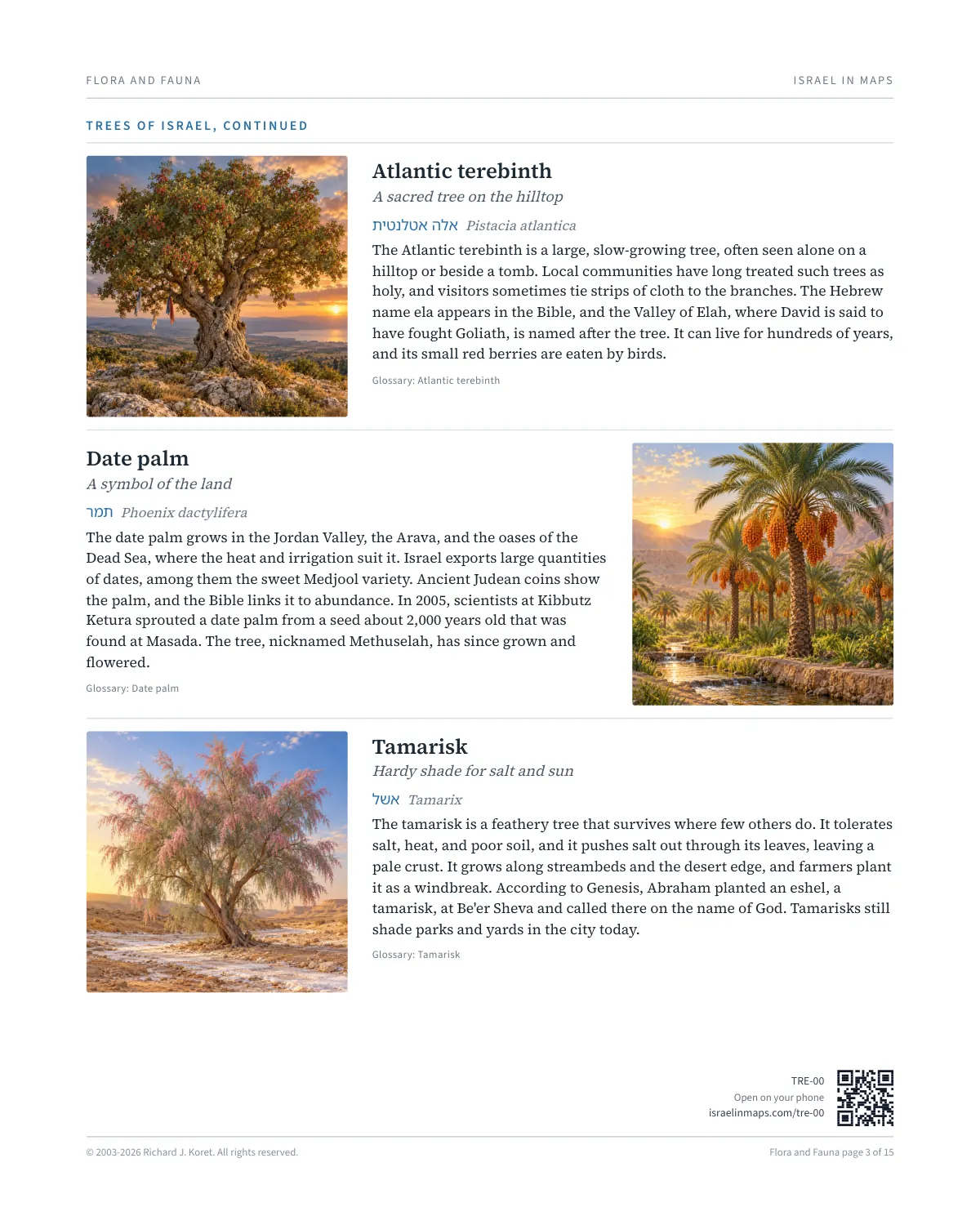
Olive trees have grown in the land for thousands of years, and some groves are said to be centuries old. Their silver-green leaves and twisted trunks are a familiar sight in the Galilee, the Judean hills, and Samaria. The olives are picked in autumn and pressed into oil, which has been a staple of local cooking and trade since ancient times. Two olive branches also frame the menorah on the emblem of the State of Israel, a sign of peace.
Glossary: Olive
Tabor oak The great oak of the Galilee
אלון התבורQuercus ithaburensis
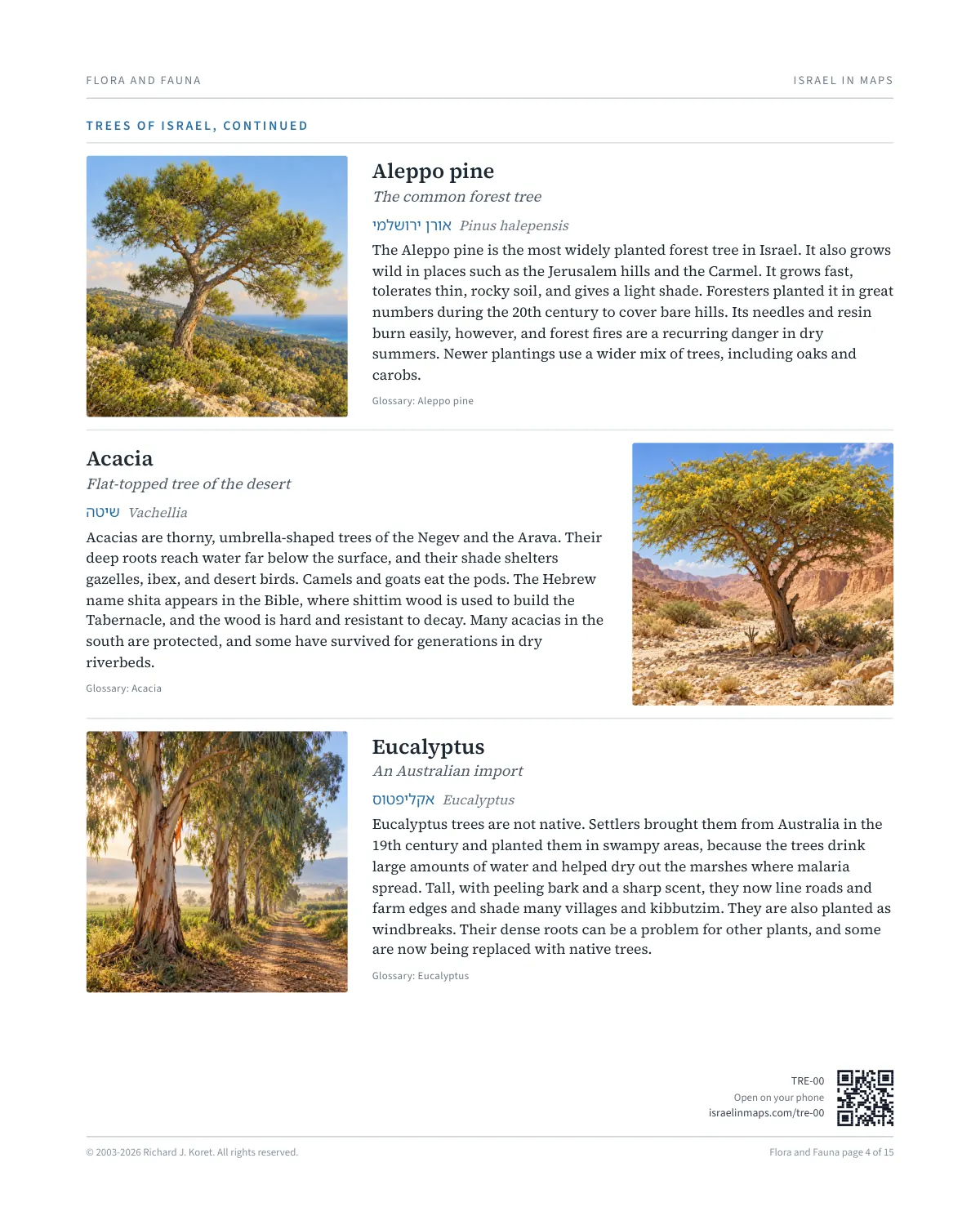
The Tabor oak is a broad, deciduous oak of the Galilee, the Golan, and the Carmel, named for Mount Tabor in the lower Galilee. It sheds its leaves in winter and grows large, with a wide crown that gives deep shade. Many stand alone in open fields, spared by farmers over the centuries and treasured by villages as shade and meeting places. Its acorns have large, scaly caps. Old oaks are protected, and some in the north are among the largest trees in the country.
Glossary: Tabor oak
Flora and Fauna page 2 of 15
TRE00 Open on your phone $.- ’)*2’ % *(„/- ›
FLORA AND FAUNA
T R E E S O F I S R A E L , CO N T I N U E D
Atlantic terebinth
A sacred tree on the hilltop
אלה אטלנטיתPistacia atlantica
The Atlantic terebinth is a large, slow-growing tree, often seen alone on a hilltop or beside a tomb. Local communities have long treated such trees as holy, and visitors sometimes tie strips of cloth to the branches. The Hebrew name ela appears in the Bible, and the Valley of Elah, where David is said to have fought Goliath, is named after the tree. It can live for hundreds of years, and its small red berries are eaten by birds.
Glossary: Atlantic terebinth
Date palm
A symbol of the land
תמרPhoenix dactylifera
The date palm grows in the Jordan Valley, the Arava, and the oases of the Dead Sea, where the heat and irrigation suit it. Israel exports large quantities of dates, among them the sweet Medjool variety. Ancient Judean coins show the palm, and the Bible links it to abundance. In 2005, scientists at Kibbutz Ketura sprouted a date palm from a seed about 2,000 years old that was found at Masada. The tree, nicknamed Methuselah, has since grown and flowered.
Glossary: Date palm
Tamarisk Hardy shade for salt and sun
אשלTamarix
The tamarisk is a feathery tree that survives where few others do. It tolerates salt, heat, and poor soil, and it pushes salt out through its leaves, leaving a pale crust. It grows along streambeds and the desert edge, and farmers plant it as a windbreak. According to Genesis, Abraham planted an eshel, a tamarisk, at Be'er Sheva and called there on the name of God. Tamarisks still shade parks and yards in the city today.
Glossary: Tamarisk
Flora and Fauna page 3 of 15
TRE00 Open on your phone $.- ’)*2’ % *(„/- ›
FLORA AND FAUNA
T R E E S O F I S R A E L , CO N T I N U E D
Aleppo pine
The common forest tree
אורן ירושלמיPinus halepensis
The Aleppo pine is the most widely planted forest tree in Israel. It also grows wild in places such as the Jerusalem hills and the Carmel. It grows fast, tolerates thin, rocky soil, and gives a light shade. Foresters planted it in great numbers during the 20th century to cover bare hills. Its needles and resin burn easily, however, and forest fires are a recurring danger in dry summers. Newer plantings use a wider mix of trees, including oaks and carobs.
Glossary: Aleppo pine
Acacia
Flat-topped tree of the desert
שיטהVachellia
Acacias are thorny, umbrella-shaped trees of the Negev and the Arava. Their deep roots reach water far below the surface, and their shade shelters gazelles, ibex, and desert birds. Camels and goats eat the pods. The Hebrew name shita appears in the Bible, where shittim wood is used to build the Tabernacle, and the wood is hard and resistant to decay. Many acacias in the south are protected, and some have survived for generations in dry riverbeds.
Glossary: Acacia
Eucalyptus
An Australian import
אקליפטוסEucalyptus
Eucalyptus trees are not native. Settlers brought them from Australia in the 19th century and planted them in swampy areas, because the trees drink large amounts of water and helped dry out the marshes where malaria spread. Tall, with peeling bark and a sharp scent, they now line roads and farm edges and shade many villages and kibbutzim. They are also planted as windbreaks. Their dense roots can be a problem for other plants, and some are now being replaced with native trees.
Glossary: Eucalyptus
Flora and Fauna page 4 of 15
TRE00 Open on your phone $.- ’)*2’ % *(„/- ›
Corrections: none recorded. This is the current version. The 2027 print edition copy is at israelnowlej.com/2027/tre-00.