
Patriarchs to the First Kings
Cite this page
Israel NOWlej (2027), TL-001, israelnowlej.com/tl-001
Short address: israelnowlej.com/tl-001
Text of this page
TIMELINE 1
Timeline 1 of 26
Patriarchs to the First Kings
2000 to 1000 BCE
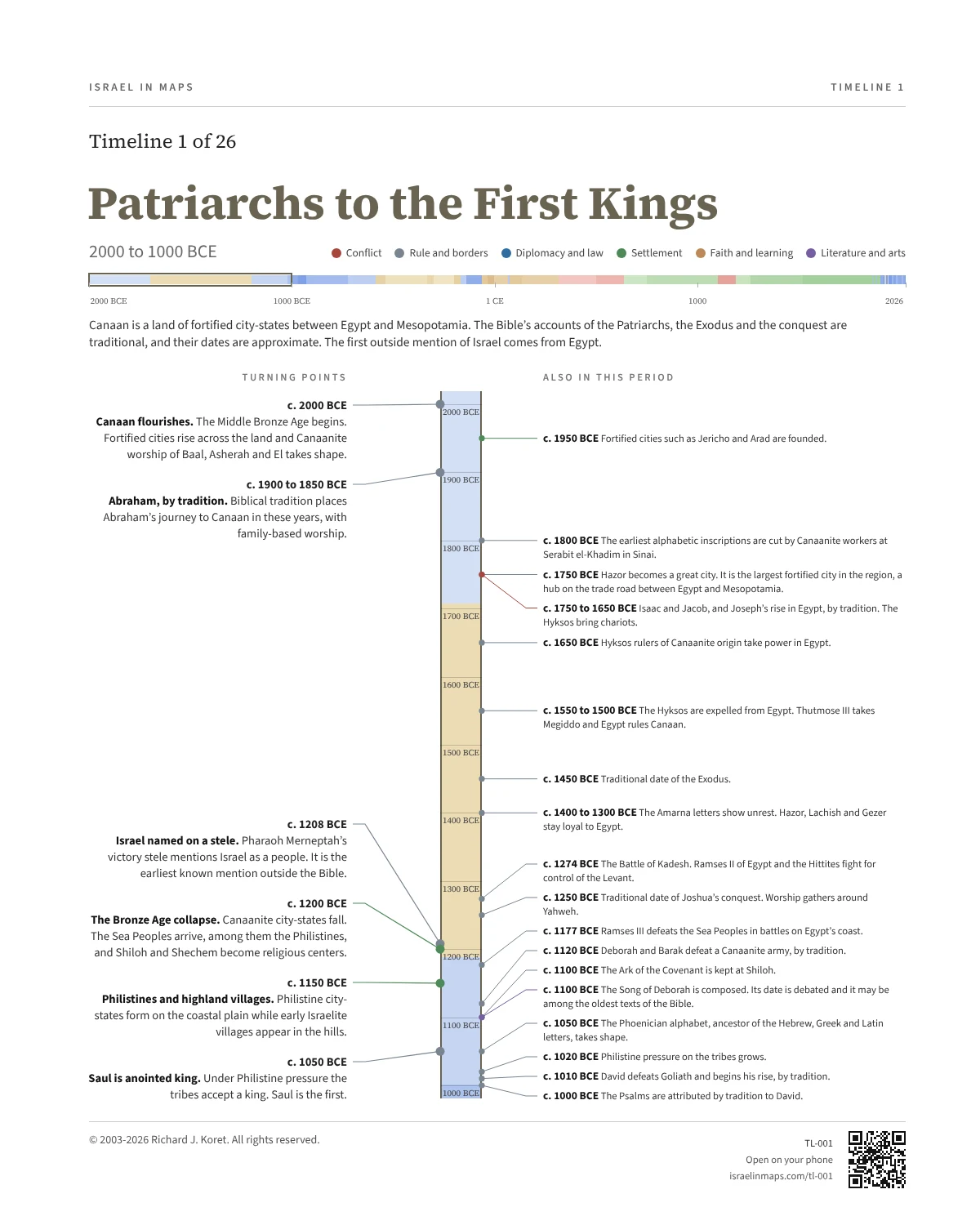
Canaan is a land of fortified city-states between Egypt and Mesopotamia. The Bible’s accounts of the Patriarchs, the Exodus and the conquest are traditional, and their dates are approximate. The first outside mention of Israel comes from Egypt.
TURNING POINTS
c. 2000 BCE Canaan flourishes. The Middle Bronze Age begins. Fortified cities rise across the land and Canaanite worship of Baal, Asherah and El takes shape.
c. 1900 to 1850 BCE Abraham, by tradition. Biblical tradition places Abraham’s journey to Canaan in these years, with family-based worship.
c. 1208 BCE Israel named on a stele. Pharaoh Merneptah’s victory stele mentions Israel as a people. It is the earliest known mention outside the Bible.
c. 1200 BCE The Bronze Age collapse. Canaanite city-states fall. The Sea Peoples arrive, among them the Philistines, and Shiloh and Shechem become religious centers.
c. 1150 BCE Philistines and highland villages. Philistine city-states form on the coastal plain while early Israelite villages appear in the hills.
c. 1050 BCE Saul is anointed king. Under Philistine pressure the tribes accept a king. Saul is the first.
ALSO IN THIS PERIOD
c. 1950 BCE Fortified cities such as Jericho and Arad are founded.
c. 1800 BCE The earliest alphabetic inscriptions are cut by Canaanite workers at Serabit el-Khadim in Sinai.
c. 1750 BCE Hazor becomes a great city. It is the largest fortified city in the region, a hub on the trade road between Egypt and Mesopotamia.
c. 1750 to 1650 BCE Isaac and Jacob, and Joseph’s rise in Egypt, by tradition. The Hyksos bring chariots.
c. 1650 BCE Hyksos rulers of Canaanite origin take power in Egypt.
c. 1550 to 1500 BCE The Hyksos are expelled from Egypt. Thutmose III takes Megiddo and Egypt rules Canaan.
c. 1450 BCE Traditional date of the Exodus.
c. 1400 to 1300 BCE The Amarna letters show unrest. Hazor, Lachish and Gezer stay loyal to Egypt.
c. 1274 BCE The Battle of Kadesh. Ramses II of Egypt and the Hittites fight for control of the Levant.
c. 1250 BCE Traditional date of Joshua’s conquest. Worship gathers around Yahweh.
c. 1177 BCE Ramses III defeats the Sea Peoples in battles on Egypt’s coast.
c. 1120 BCE Deborah and Barak defeat a Canaanite army, by tradition.
c. 1100 BCE The Ark of the Covenant is kept at Shiloh.
c. 1100 BCE The Song of Deborah is composed. Its date is debated and it may be among the oldest texts of the Bible.
c. 1050 BCE The Phoenician alphabet, ancestor of the Hebrew, Greek and Latin letters, takes shape.
c. 1020 BCE Philistine pressure on the tribes grows.
c. 1010 BCE David defeats Goliath and begins his rise, by tradition.
c. 1000 BCE The Psalms are attributed by tradition to David.
Corrections: none recorded. This is the current version.