
Patriarchs to the First Kings
Cite this page
Israel NOWlej (2027), TL-001, p. 110, israelnowlej.com/tl-001
Short address: israelnowlej.com/tl-001
Text of this page
TIMELINE 1
Timeline 1 of 19
Patriarchs to the First Kings
2000 to 1000 BCE Conflict Rule and borders Diplomacy and law Settlement Faith and learning Literature and arts
2000 BCE 1000 BCE 1 CE
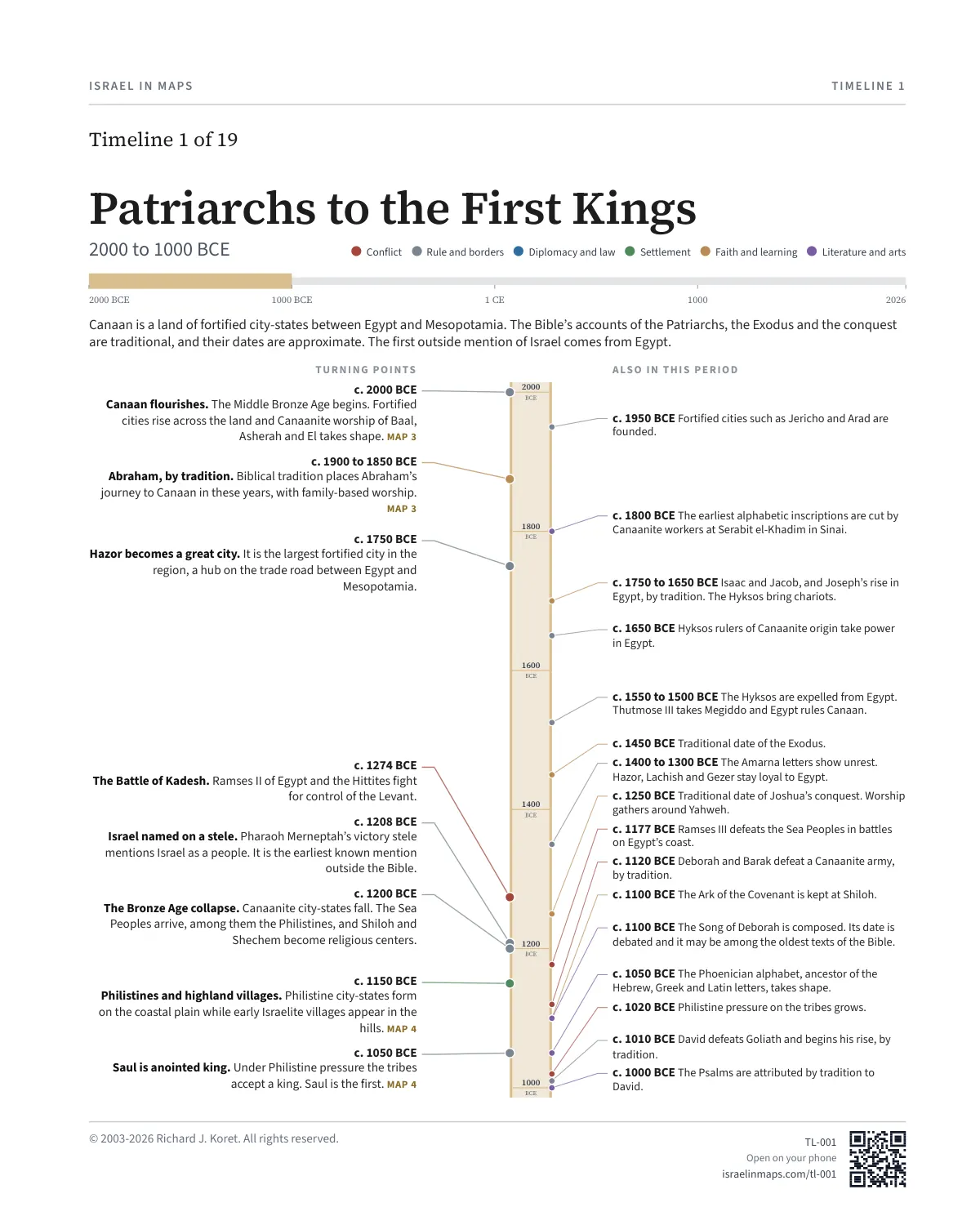
Canaan is a land of fortified city-states between Egypt and Mesopotamia. The Bible’s accounts of the Patriarchs, the Exodus and the conquest are traditional, and their dates are approximate. The first outside mention of Israel comes from Egypt.
TURNING POINTS ALSO IN THIS PERIOD
BCE
BCE
BCE
BCE
BCE
BCE
c. 2000 BCE Canaan flourishes. The Middle Bronze Age begins. Fortified
cities rise across the land and Canaanite worship of Baal,
Asherah and El takes shape. MAP 3
c. 1900 to 1850 BCE Abraham, by tradition. Biblical tradition places Abraham’s journey to Canaan in these years, with family-based worship.
MAP 3
c. 1208 BCE Israel named on a stele. Pharaoh Merneptah’s victory stele mentions Israel as a people. It is the earliest known mention
outside the Bible.
c. 1200 BCE The Bronze Age collapse. Canaanite city-states fall. The Sea
Peoples arrive, among them the Philistines, and Shiloh and
Shechem become religious centers.
c. 1150 BCE Philistines and highland villages. Philistine city-states form on the coastal plain while early Israelite villages appear in the
hills. MAP 4
c. 1050 BCE Saul is anointed king. Under Philistine pressure the tribes
accept a king. Saul is the first. MAP 4
c. 1750 BCE Hazor becomes a great city. It is the largest fortified city in the
region, a hub on the trade road between Egypt and
Mesopotamia.
c. 1274 BCE The Battle of Kadesh. Ramses II of Egypt and the Hittites fight
for control of the Levant.
c. 1950 BCE Fortified cities such as Jericho and Arad are founded.
c. 1750 to 1650 BCE Isaac and Jacob, and Joseph’s rise in Egypt, by tradition. The Hyksos bring chariots.
c. 1550 to 1500 BCE The Hyksos are expelled from Egypt. Thutmose III takes Megiddo and Egypt rules Canaan.
c. 1450 BCE Traditional date of the Exodus. c. 1400 to 1300 BCE The Amarna letters show unrest. Hazor, Lachish and Gezer stay loyal to Egypt. c. 1250 BCE Traditional date of Joshua’s conquest. Worship gathers around Yahweh.
c. 1120 BCE Deborah and Barak defeat a Canaanite army, by tradition.
c. 1100 BCE The Ark of the Covenant is kept at Shiloh.
c. 1020 BCE Philistine pressure on the tribes grows.
c. 1010 BCE David defeats Goliath and begins his rise, by tradition.
c. 1650 BCE Hyksos rulers of Canaanite origin take power in Egypt.
c. 1177 BCE Ramses III defeats the Sea Peoples in battles on Egypt’s coast.
c. 1800 BCE The earliest alphabetic inscriptions are cut by Canaanite workers at Serabit el-Khadim in Sinai.
c. 1100 BCE The Song of Deborah is composed. Its date is debated and it may be among the oldest texts of the Bible.
c. 1050 BCE The Phoenician alphabet, ancestor of the Hebrew, Greek and Latin letters, takes shape.
c. 1000 BCE The Psalms are attributed by tradition to David.
TL001 Open on your phone $.- ’)*2’ % *(„/’›
Corrections: none recorded. This is the current version. The 2027 print edition copy is at israelnowlej.com/2027/tl-001.