
The Dead Sea
In this section
Text of this page
A TASTE OF ISRAEL
The Dead Sea
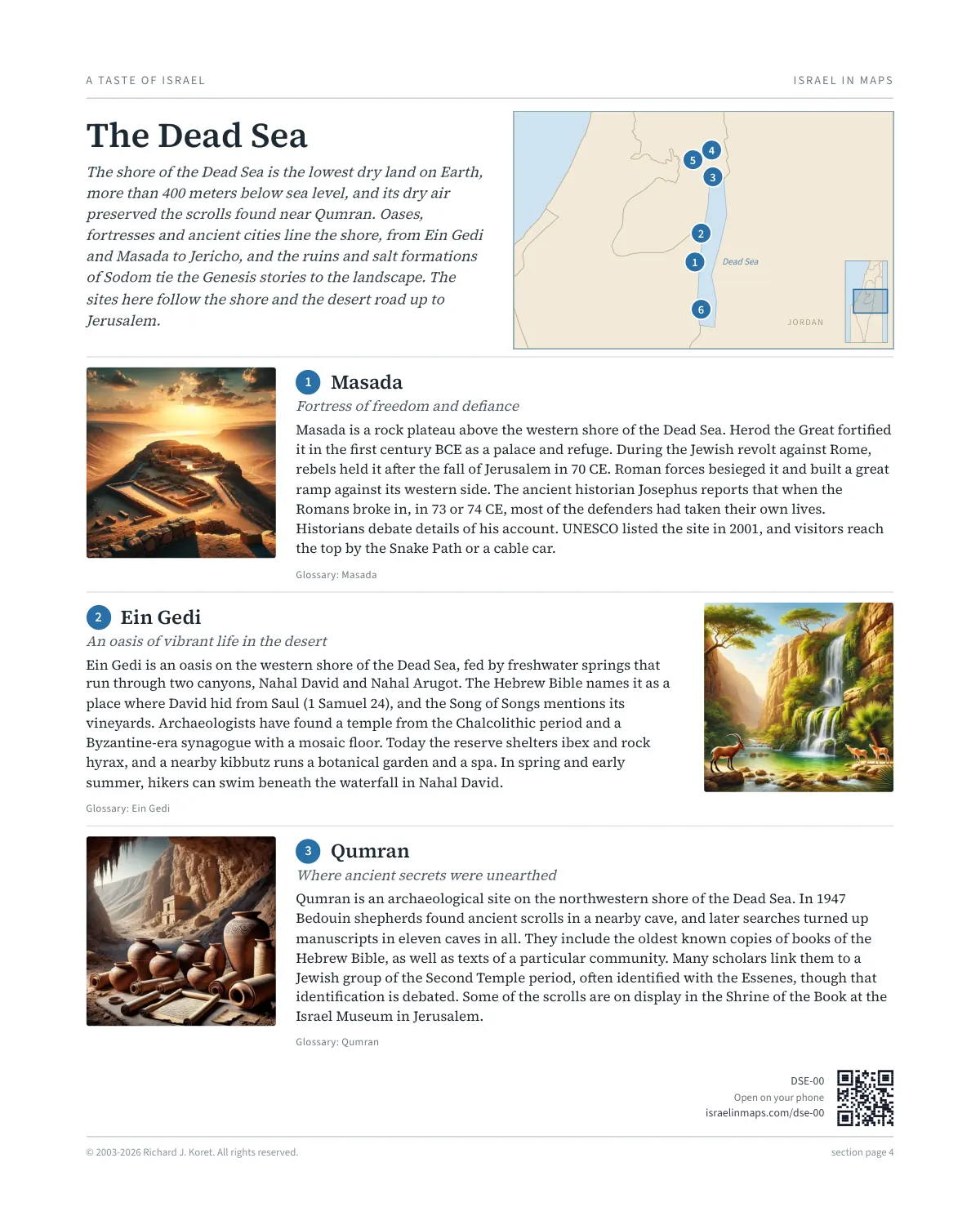
The shore of the Dead Sea is the lowest dry land on Earth, more than 400 meters below sea level, and its dry air preserved the scrolls found near Qumran. Oases, fortresses and ancient cities line the shore, from Ein Gedi and Masada to Jericho, and the ruins and salt formations of Sodom tie the Genesis stories to the landscape. The
sites here follow the shore and the desert road up to Jerusalem.
Dead Sea
JORDAN
Masada
Fortress of freedom and defiance
Masada is a rock plateau above the western shore of the Dead Sea. Herod the Great fortified it in the first century BCE as a palace and refuge. During the Jewish revolt against Rome, rebels held it after the fall of Jerusalem in 70 CE. Roman forces besieged it and built a great ramp against its western side. The ancient historian Josephus reports that when the Romans broke in, in 73 or 74 CE, most of the defenders had taken their own lives. Historians debate details of his account. UNESCO listed the site in 2001, and visitors reach the top by the Snake Path or a cable car.
Glossary: Masada
Ein Gedi
An oasis of vibrant life in the desert
Ein Gedi is an oasis on the western shore of the Dead Sea, fed by freshwater springs that run through two canyons, Nahal David and Nahal Arugot. The Hebrew Bible names it as a place where David hid from Saul (1 Samuel 24), and the Song of Songs mentions its vineyards. Archaeologists have found a temple from the Chalcolithic period and a Byzantine-era synagogue with a mosaic floor. Today the reserve shelters ibex and rock hyrax, and a nearby kibbutz runs a botanical garden and a spa. In spring and early summer, hikers can swim beneath the waterfall in Nahal David.
Glossary: Ein Gedi
Qumran
Where ancient secrets were unearthed
Qumran is an archaeological site on the northwestern shore of the Dead Sea. In 1947 Bedouin shepherds found ancient scrolls in a nearby cave, and later searches turned up manuscripts in eleven caves in all. They include the oldest known copies of books of the Hebrew Bible, as well as texts of a particular community. Many scholars link them to a Jewish group of the Second Temple period, often identified with the Essenes, though that identification is debated. Some of the scrolls are on display in the Shrine of the Book at the Israel Museum in Jerusalem.
Glossary: Qumran
section page 4
DSE00 Open on your phone $.- ’)*2’ % *(„ . ›
A TASTE OF ISRAEL
T H E D E A D S E A , CO N T I N U E D
Jericho
An ancient city famous for its walls
Jericho, near the Jordan River, is among the oldest known inhabited places, with traces of settlement going back about 10,000 years. In the Book of Joshua its walls fell after the Israelites marched around them for seven days, though archaeologists disagree about what the excavated ruins show. Abundant springs have made it an oasis for millennia, and it is known for its dates. Herod the Great built a winter palace nearby. Jericho is administered by the Palestinian Authority and Israelis are barred from entering, so visitors should check current conditions.
Glossary: Jericho
Wadi Qelt
A trail through time
Wadi Qelt is a desert canyon that carries a stream from the hills near Jerusalem down to Jericho. An ancient road through it linked the two cities, and aqueducts from the Hasmonean and Herodian eras that fed Jericho's palaces and fields can still be seen. St. George's Monastery, a Greek Orthodox monastery founded in the fifth century, clings to the cliff face. Hikers walk the canyon in winter and spring when the stream runs. Parts lie in areas under Palestinian Authority control, and attacks on hikers have occurred, so most go in groups.
Glossary: Wadi Qelt
Sodom and Gomorrah
Cities of the plain, in tradition and legend
According to Genesis, Sodom and Gomorrah were cities of the plain destroyed by fire and brimstone, while Lot and his daughters escaped. Their exact location is unknown, and scholars have proposed sites on both the southern and northern shores of the Dead Sea. A ridge called Mount Sodom, made largely of salt, rises at the southern end of the sea. Its caves and weathered pillars include a formation that visitors call Lot's Wife. The area evokes the story, but no archaeological evidence ties it to the biblical cities.
Glossary: Sodom and Gomorrah
section page 5
DSE00 Open on your phone $.- ’)*2’ % *(„ . ›