
The Judean Hills
In this section
Text of this page
A TASTE OF ISRAEL
The Judean Hills
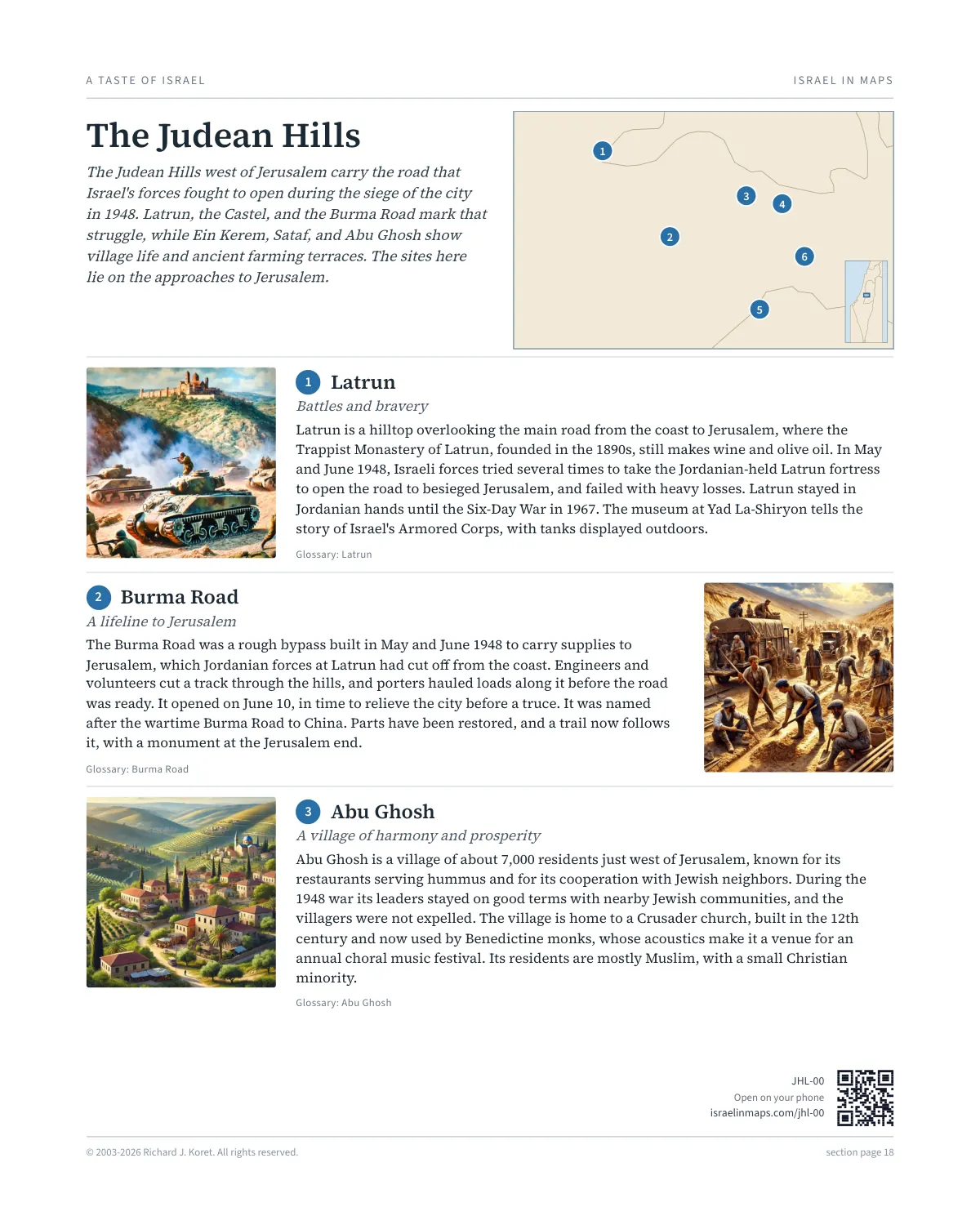
The Judean Hills west of Jerusalem carry the road that Israel's forces fought to open during the siege of the city in 1948. Latrun, the Castel, and the Burma Road mark that struggle, while Ein Kerem, Sataf, and Abu Ghosh show village life and ancient farming terraces. The sites here lie on the approaches to Jerusalem.
Latrun
Battles and bravery
Latrun is a hilltop overlooking the main road from the coast to Jerusalem, where the Trappist Monastery of Latrun, founded in the 1890s, still makes wine and olive oil. In May and June 1948, Israeli forces tried several times to take the Jordanian-held Latrun fortress to open the road to besieged Jerusalem, and failed with heavy losses. Latrun stayed in Jordanian hands until the Six-Day War in 1967. The museum at Yad La-Shiryon tells the story of Israel's Armored Corps, with tanks displayed outdoors.
Glossary: Latrun
Burma Road
A lifeline to Jerusalem
The Burma Road was a rough bypass built in May and June 1948 to carry supplies to Jerusalem, which Jordanian forces at Latrun had cut off from the coast. Engineers and volunteers cut a track through the hills, and porters hauled loads along it before the road was ready. It opened on June 10, in time to relieve the city before a truce. It was named after the wartime Burma Road to China. Parts have been restored, and a trail now follows it, with a monument at the Jerusalem end.
Glossary: Burma Road
Abu Ghosh
A village of harmony and prosperity
Abu Ghosh is a village of about 7,000 residents just west of Jerusalem, known for its restaurants serving hummus and for its cooperation with Jewish neighbors. During the 1948 war its leaders stayed on good terms with nearby Jewish communities, and the villagers were not expelled. The village is home to a Crusader church, built in the 12th century and now used by Benedictine monks, whose acoustics make it a venue for an annual choral music festival. Its residents are mostly Muslim, with a small Christian minority.
Glossary: Abu Ghosh
section page 18
JHL00 Open on your phone $.- ’)*2’ % *(„%#’›
A TASTE OF ISRAEL
T H E J U D E A N H I L LS , CO N T I N U E D
Castel National Park
Conquering the high ground
The Castel is a hilltop with a Crusader fortress above the road to Jerusalem, beside the site of the Arab village of al-Qastal. Control of it changed hands several times in April 1948, during Operation Nachshon, when Haganah and Palmach forces fought to open the road, and the Arab commander Abd al-Qadir al-Husayni was killed in the fighting. The park preserves trenches, a memorial, and the Crusader ruins, and offers a view over the Jerusalem corridor.
Glossary: Castel National Park
Sataf
Ancient agriculture revived
Sataf is a nature reserve in the Jerusalem hills where terraced hillsides and a spring-fed irrigation system recall farming that goes back to biblical times. Arab villagers cultivated the terraces until 1948, and Israeli volunteers restored them in recent decades. Visitors can walk through terraced gardens planted with olive, fig, and grape, and a small organic farm sells produce. Trails lead to the spring and through the forest, and the site is a favorite for family picnics. Archaeological remains include a tunnel and a pool.
Glossary: Sataf
Ein Kerem
A village of beauty and spirituality
Ein Kerem, now a Jerusalem neighborhood in a green valley, is traditionally the birthplace of John the Baptist, and the Church of St. John the Baptist and the Church of the Visitation mark the events. Mary's Spring, where villagers drew water for centuries, lies at the center. Until 1948 it was an Arab village, and after the war Jewish immigrants and later artists moved into the old stone houses. Today its alleys hold galleries and restaurants, and the Hadassah Medical Center, with Marc Chagall's stained-glass windows, stands on the hill above.
Glossary: Ein Kerem
section page 19
JHL00 Open on your phone $.- ’)*2’ % *(„%#’›