
Jerusalem
In this section
Text of this page
A TASTE OF ISRAEL
Jerusalem
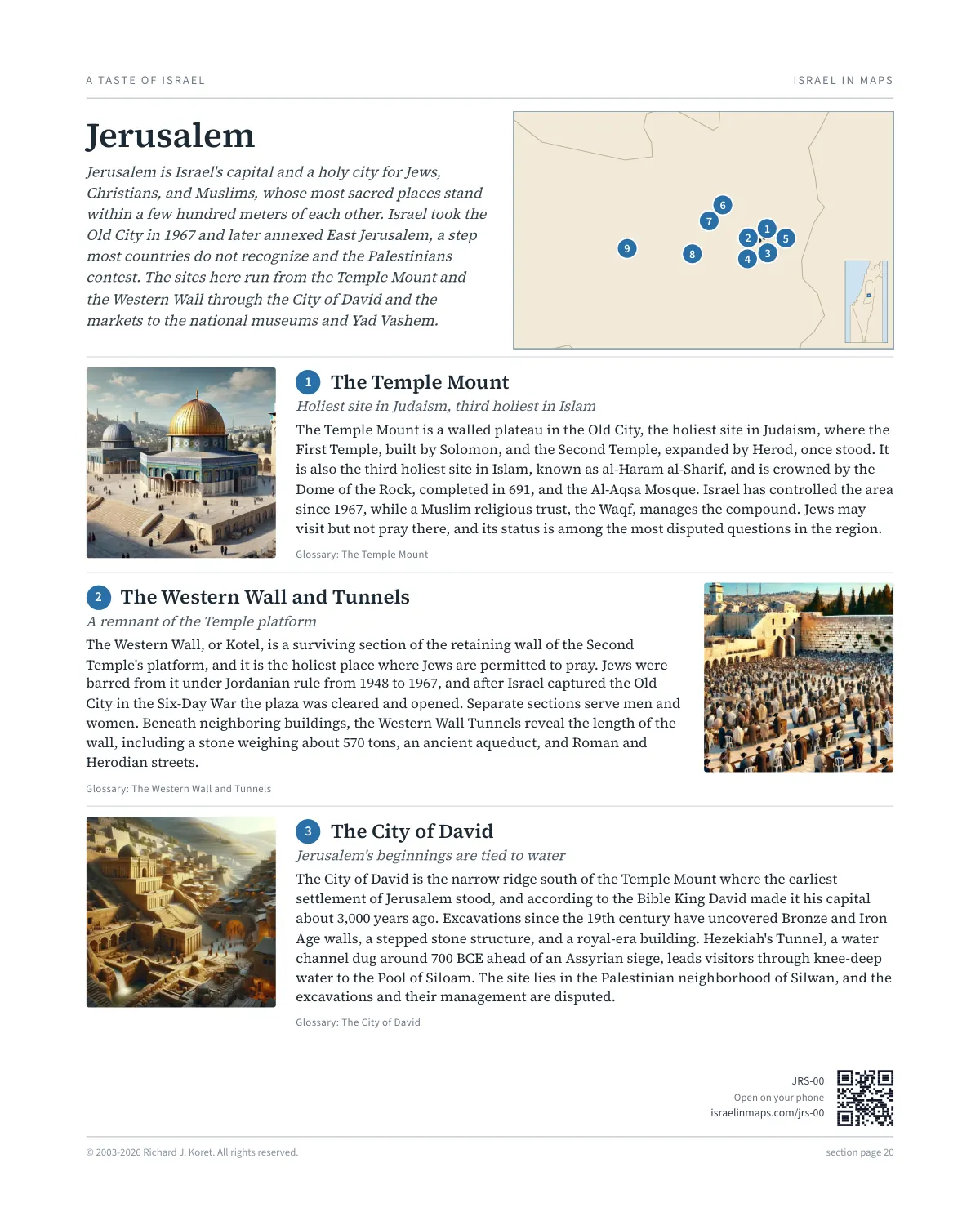
Jerusalem is Israel's capital and a holy city for Jews, Christians, and Muslims, whose most sacred places stand within a few hundred meters of each other. Israel took the Old City in 1967 and later annexed East Jerusalem, a step most countries do not recognize and the Palestinians contest. The sites here run from the Temple Mount and
the Western Wall through the City of David and the markets to the national museums and Yad Vashem.
The Temple Mount
Holiest site in Judaism, third holiest in Islam
The Temple Mount is a walled plateau in the Old City, the holiest site in Judaism, where the First Temple, built by Solomon, and the Second Temple, expanded by Herod, once stood. It is also the third holiest site in Islam, known as al-Haram al-Sharif, and is crowned by the Dome of the Rock, completed in 691, and the Al-Aqsa Mosque. Israel has controlled the area since 1967, while a Muslim religious trust, the Waqf, manages the compound. Jews may visit but not pray there, and its status is among the most disputed questions in the region.
Glossary: The Temple Mount
The Western Wall and Tunnels
A remnant of the Temple platform
The Western Wall, or Kotel, is a surviving section of the retaining wall of the Second Temple's platform, and it is the holiest place where Jews are permitted to pray. Jews were barred from it under Jordanian rule from 1948 to 1967, and after Israel captured the Old City in the Six-Day War the plaza was cleared and opened. Separate sections serve men and women. Beneath neighboring buildings, the Western Wall Tunnels reveal the length of the wall, including a stone weighing about 570 tons, an ancient aqueduct, and Roman and Herodian streets.
Glossary: The Western Wall and Tunnels
The City of David
Jerusalem's beginnings are tied to water
The City of David is the narrow ridge south of the Temple Mount where the earliest settlement of Jerusalem stood, and according to the Bible King David made it his capital about 3,000 years ago. Excavations since the 19th century have uncovered Bronze and Iron Age walls, a stepped stone structure, and a royal-era building. Hezekiah's Tunnel, a water channel dug around 700 BCE ahead of an Assyrian siege, leads visitors through knee-deep water to the Pool of Siloam. The site lies in the Palestinian neighborhood of Silwan, and the excavations and their management are disputed.
Glossary: The City of David
section page 20
JRS00 Open on your phone $.- ’)*2’ % *(„%-.›
A TASTE OF ISRAEL
J E R US A L E M , CO N T I N U E D
Mount Zion
The hill that gave Zionism its name
Mount Zion is the hill just south of the Old City walls, and its name has come to stand for Jerusalem and for the longing of the Jewish people for the land. Tradition places here the Tomb of King David, though scholars doubt it, and the Room of the Last Supper, called the Cenacle. The Dormition Abbey, a German Benedictine church completed in 1910, commemorates the falling asleep of the Virgin Mary. A Christian cemetery on the slope holds the grave of Oskar Schindler.
Glossary: Mount Zion
The Mount of Olives and Gethsemane
A panoramic view of history
The Mount of Olives is the ridge east of the Old City, with a sweeping view over the Temple Mount. Its slopes hold the oldest and most important Jewish cemetery, in use for some 3,000 years, as well as Christian churches and a Russian Orthodox convent. Jews could not visit the cemetery between 1948 and 1967. At the foot of the ridge, the Garden of Gethsemane is where, in the Gospels, Jesus prayed before his arrest, and its ancient olive trees are among the oldest in the region. The Church of All Nations stands beside it.
Glossary: Mount of Olives
Mea She'arim
Step back a century or two
Mea She'arim is a neighborhood north of the Old City, founded in 1874, and its name means a hundred gates, after a verse in Genesis. Its crowded lanes, small synagogues, and study halls are home to ultra-Orthodox Jews, many of whom dress as their ancestors did in Eastern Europe. Signs ask visitors to dress modestly and not to photograph residents. The community has long disagreed with secular Israelis over Sabbath observance and over military service, which remains a continuing political dispute.
Glossary: Mea She'arim
section page 21
JRS00 Open on your phone $.- ’)*2’ % *(„%-.›
A TASTE OF ISRAEL
J E R US A L E M , CO N T I N U E D
Mahane Yehuda Market
The bustling tastes of Jerusalem
Mahane Yehuda, known as the Shuk, is Jerusalem's main open-air market, founded in the late 19th century. Its lanes hold stalls with produce, spices, baked goods, halva, and cheese, and vendors call out prices in a mix of languages. By night, bars and restaurants fill the alleys and attract a younger crowd. The market has been the target of terror attacks, notably on July 30, 1997, when two suicide bombers killed 16 people and wounded 178. It draws shoppers and visitors in large numbers, especially before the Sabbath.
Glossary: Mahane Yehuda Market
The Israel Museum and Shrine of the Book
Art, archaeology, and the scrolls
The Israel Museum, founded in 1965, is Israel's national museum, with archaeology, Judaica, fine art, and a sculpture garden designed by Isamu Noguchi. Its Shrine of the Book, a white dome shaped like the lid of a jar that held the Dead Sea Scrolls, houses scrolls found at Qumran and elsewhere. The museum also has a large model of Jerusalem as it looked in the Second Temple period. Visitors can follow the story of the land from prehistory to contemporary art in a single hilltop campus.
Glossary: Israel Museum and Shrine of the Book
Yad Vashem
Remembrance of the Six Million
Yad Vashem, on the Mount of Remembrance in Jerusalem, is Israel's national Holocaust memorial and research center, established by law in 1953. Its history museum tells the story of the destruction of European Jewry through documents, objects, and testimony, and its Hall of Names records the six million Jews who were murdered. A memorial to the 1.5 million children who died, an Avenue of the Righteous Among the Nations honoring non-Jews who rescued Jews, and a research institute and archive complete the campus. Visitors can search victims' names in its databases.
Glossary: Yad Vashem
section page 22
JRS00 Open on your phone $.- ’)*2’ % *(„%-.›