
Judea and Samaria
In this section
Text of this page
A TASTE OF ISRAEL
Judea and Samaria
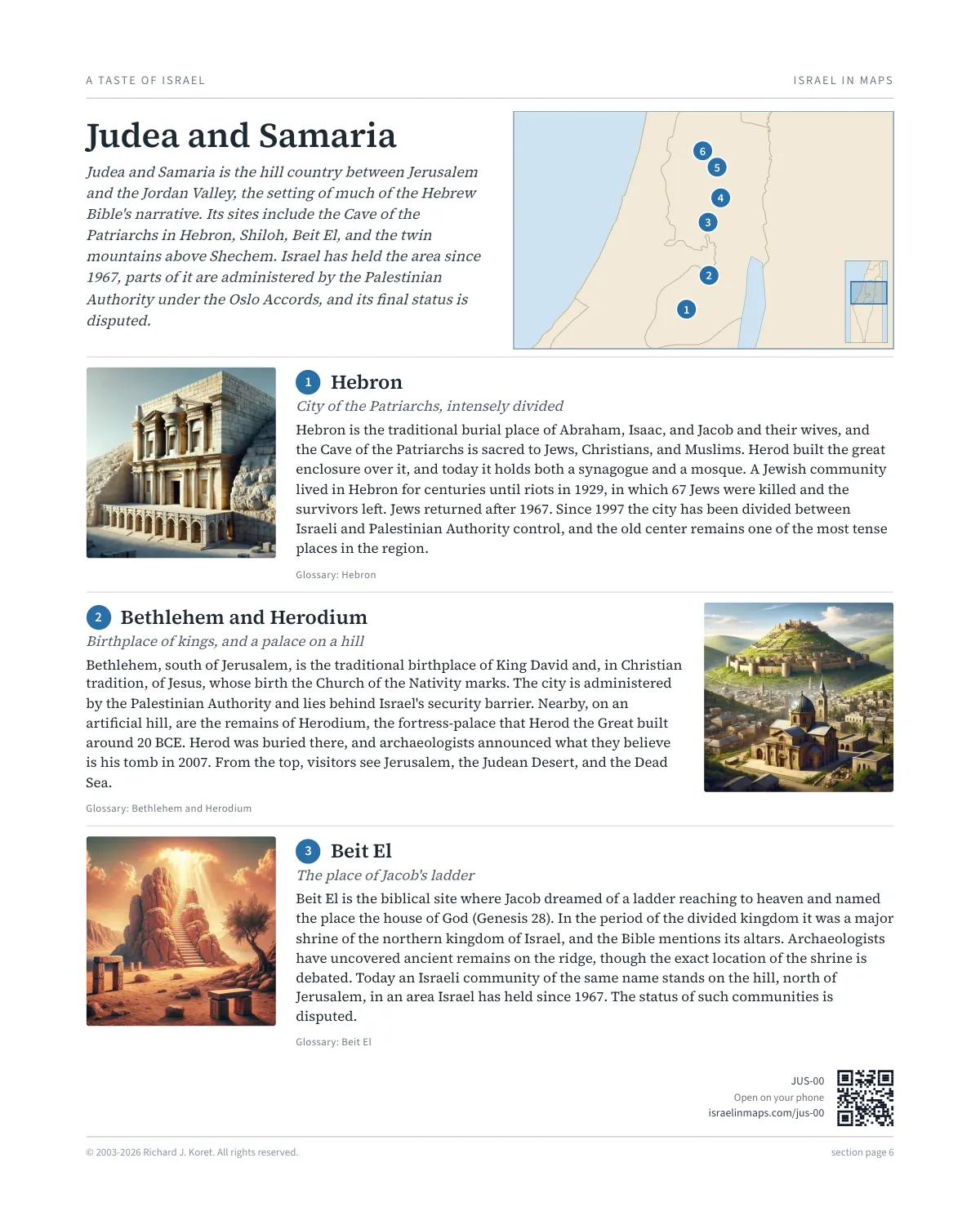
Judea and Samaria is the hill country between Jerusalem and the Jordan Valley, the setting of much of the Hebrew Bible's narrative. Its sites include the Cave of the Patriarchs in Hebron, Shiloh, Beit El, and the twin mountains above Shechem. Israel has held the area since 1967, parts of it are administered by the Palestinian
Authority under the Oslo Accords, and its final status is disputed.
Hebron
City of the Patriarchs, intensely divided
Hebron is the traditional burial place of Abraham, Isaac, and Jacob and their wives, and the Cave of the Patriarchs is sacred to Jews, Christians, and Muslims. Herod built the great enclosure over it, and today it holds both a synagogue and a mosque. A Jewish community lived in Hebron for centuries until riots in 1929, in which 67 Jews were killed and the survivors left. Jews returned after 1967. Since 1997 the city has been divided between Israeli and Palestinian Authority control, and the old center remains one of the most tense places in the region.
Glossary: Hebron
Bethlehem and Herodium
Birthplace of kings, and a palace on a hill
Bethlehem, south of Jerusalem, is the traditional birthplace of King David and, in Christian tradition, of Jesus, whose birth the Church of the Nativity marks. The city is administered by the Palestinian Authority and lies behind Israel's security barrier. Nearby, on an artificial hill, are the remains of Herodium, the fortress-palace that Herod the Great built around 20 BCE. Herod was buried there, and archaeologists announced what they believe is his tomb in 2007. From the top, visitors see Jerusalem, the Judean Desert, and the Dead Sea.
Glossary: Bethlehem and Herodium
Beit El
The place of Jacob's ladder
Beit El is the biblical site where Jacob dreamed of a ladder reaching to heaven and named the place the house of God (Genesis 28). In the period of the divided kingdom it was a major shrine of the northern kingdom of Israel, and the Bible mentions its altars. Archaeologists have uncovered ancient remains on the ridge, though the exact location of the shrine is debated. Today an Israeli community of the same name stands on the hill, north of Jerusalem, in an area Israel has held since 1967. The status of such communities is disputed.
Glossary: Beit El
section page 6
JUS00 Open on your phone $.- ’)*2’ % *(„%0.›
A TASTE OF ISRAEL
J U D E A A N D S A M A R I A , CO N T I N U E D
Shiloh
Home of the Tabernacle
Shiloh was Israel's chief religious center for much of the period of the judges, about four centuries according to the Bible, and housed the Tabernacle. Hannah prayed here for a child, and her son Samuel grew up serving in its sanctuary (1 Samuel 1). Excavations have found remains of a large Iron Age settlement and of a Byzantine church with mosaics. The site is in Samaria, north of Jerusalem, in an area Israel has administered since 1967. A visitor center offers multimedia exhibits and a view over the ancient mound.
Glossary: Shiloh
Mounts Gerizim and Ebal
The mountains of blessing and curse
Mount Gerizim and Mount Ebal stand on either side of the valley at Shechem, the modern city of Nablus. In Deuteronomy and Joshua, the Israelites stood on the two mountains to hear blessings and curses read after crossing the Jordan. Gerizim is the holy mountain of the Samaritans, one of the world's smallest and oldest religious communities, whose few hundred members still hold a Passover sacrifice on its summit. Archaeologists have found the remains of an ancient Samaritan temple on Gerizim and a stone structure on Ebal that some identify as an altar. The area is under mixed Israeli and Palestinian administration.
Glossary: Mounts Gerizim and Ebal
Sebastia
Capital of a biblical kingdom
Sebastia, in northern Samaria, was the site of ancient Samaria, the capital of the northern kingdom of Israel, which King Omri founded in the ninth century BCE. Herod the Great rebuilt it in Roman style and renamed it Sebaste in honor of Augustus. Visitors can see a Roman forum, a theater, and the foundations of an Israelite royal palace. Later a Crusader cathedral was built over a church said to hold the tomb of John the Baptist. The ruins sit above a village of the same name, in an area administered by the Palestinian Authority.
Glossary: Sebastia
section page 7
JUS00 Open on your phone $.- ’)*2’ % *(„%0.›