
The Southern Plain (Shfela)
In this section
Text of this page
A TASTE OF ISRAEL
The Southern Plain (Shfela)
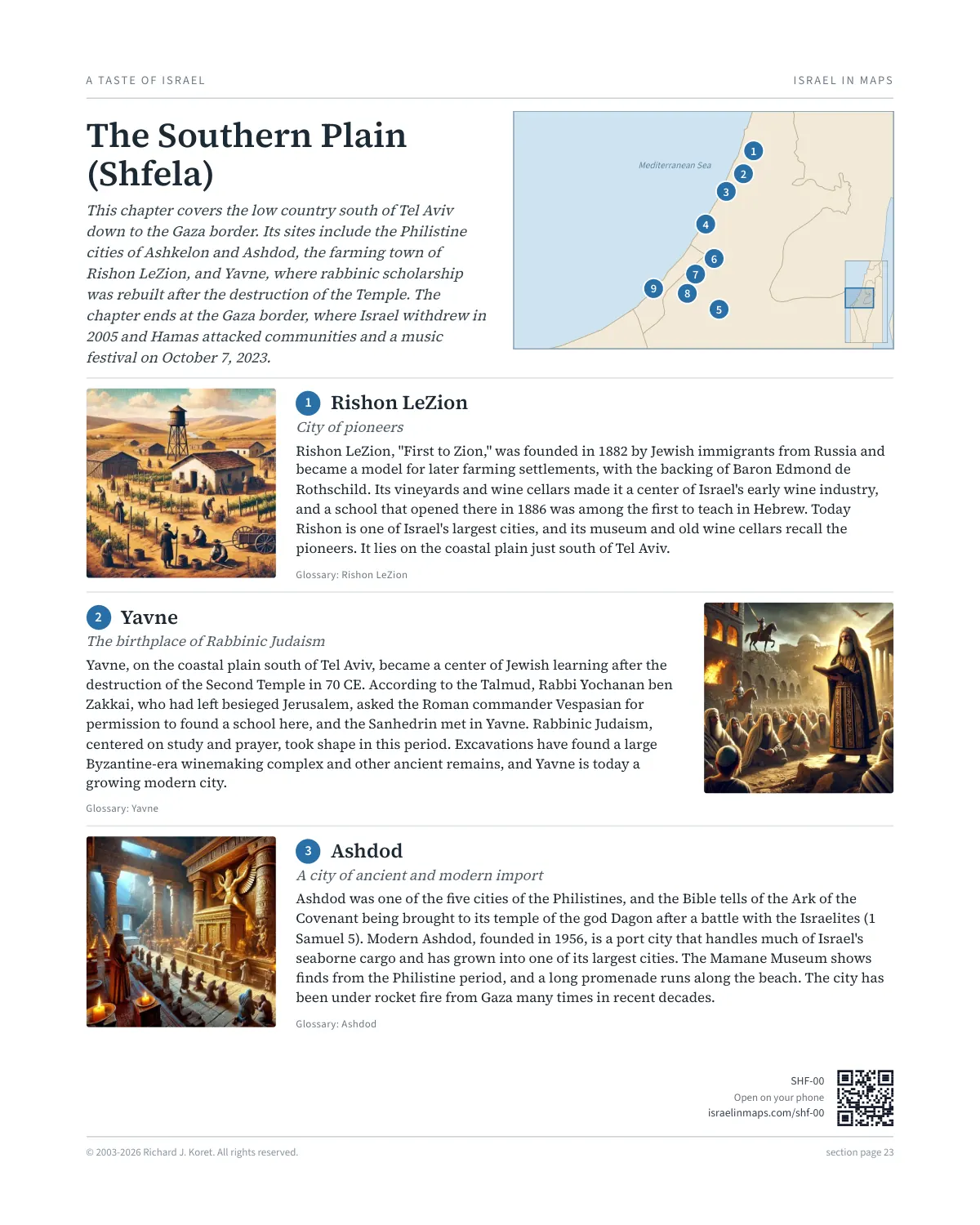
This chapter covers the low country south of Tel Aviv down to the Gaza border. Its sites include the Philistine cities of Ashkelon and Ashdod, the farming town of Rishon LeZion, and Yavne, where rabbinic scholarship was rebuilt after the destruction of the Temple. The chapter ends at the Gaza border, where Israel withdrew in 2005 and Hamas attacked communities and a music festival on October 7, 2023.
Mediterranean Sea
Rishon LeZion
City of pioneers
Rishon LeZion, "First to Zion," was founded in 1882 by Jewish immigrants from Russia and became a model for later farming settlements, with the backing of Baron Edmond de Rothschild. Its vineyards and wine cellars made it a center of Israel's early wine industry, and a school that opened there in 1886 was among the first to teach in Hebrew. Today Rishon is one of Israel's largest cities, and its museum and old wine cellars recall the pioneers. It lies on the coastal plain just south of Tel Aviv.
Glossary: Rishon LeZion
Yavne
The birthplace of Rabbinic Judaism
Yavne, on the coastal plain south of Tel Aviv, became a center of Jewish learning after the destruction of the Second Temple in 70 CE. According to the Talmud, Rabbi Yochanan ben Zakkai, who had left besieged Jerusalem, asked the Roman commander Vespasian for permission to found a school here, and the Sanhedrin met in Yavne. Rabbinic Judaism, centered on study and prayer, took shape in this period. Excavations have found a large Byzantine-era winemaking complex and other ancient remains, and Yavne is today a growing modern city.
Glossary: Yavne
Ashdod
A city of ancient and modern import
Ashdod was one of the five cities of the Philistines, and the Bible tells of the Ark of the Covenant being brought to its temple of the god Dagon after a battle with the Israelites (1 Samuel 5). Modern Ashdod, founded in 1956, is a port city that handles much of Israel's seaborne cargo and has grown into one of its largest cities. The Mamane Museum shows finds from the Philistine period, and a long promenade runs along the beach. The city has been under rocket fire from Gaza many times in recent decades.
Glossary: Ashdod
section page 23
SHF00 Open on your phone $.- ’)*2’ % *(„.#!›
A TASTE OF ISRAEL
T H E S O U T H E R N P L A I N ( S H F E L A ) , CO N T I N U E D
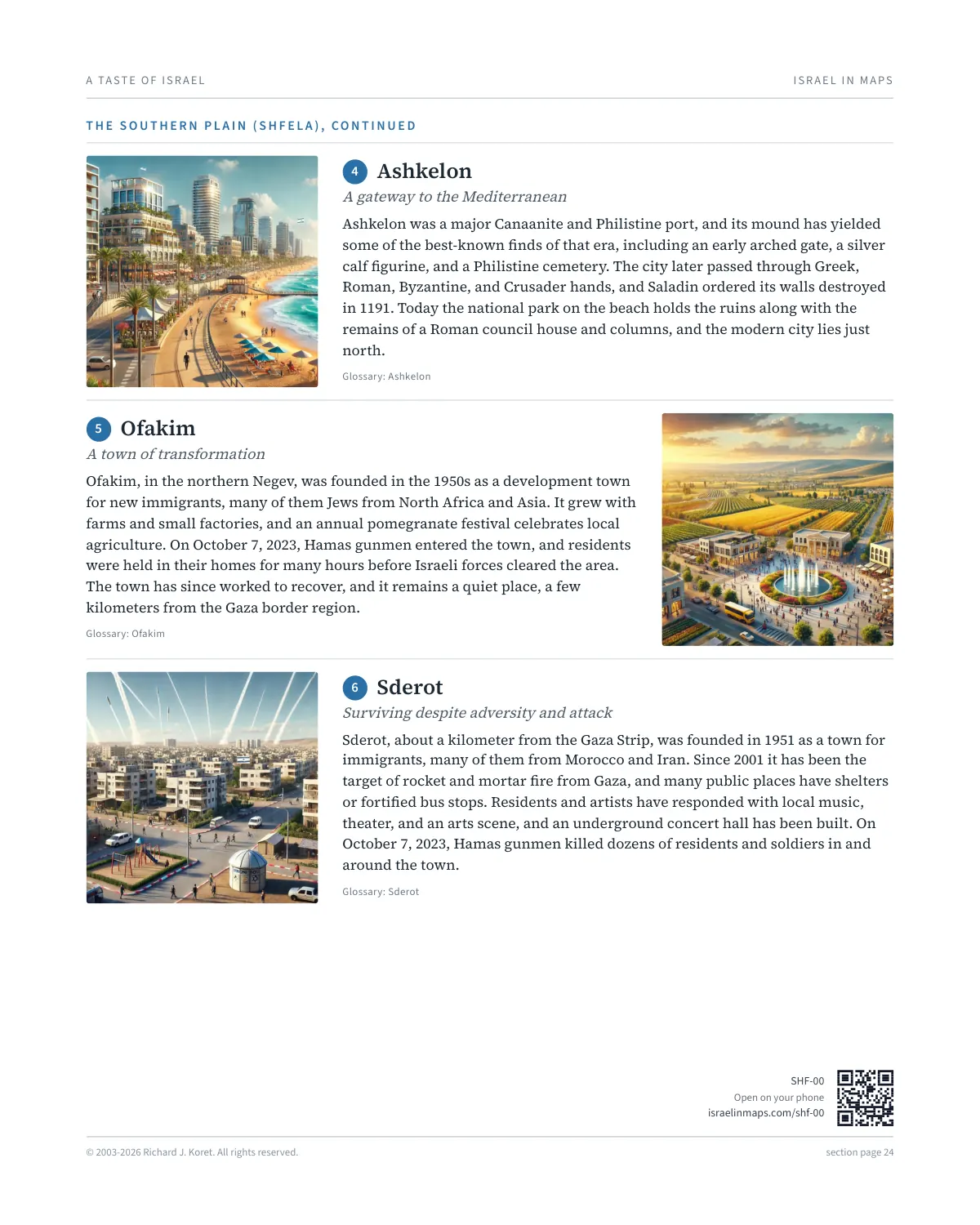
Ashkelon
A gateway to the Mediterranean
Ashkelon was a major Canaanite and Philistine port, and its mound has yielded some of the best-known finds of that era, including an early arched gate, a silver calf figurine, and a Philistine cemetery. The city later passed through Greek, Roman, Byzantine, and Crusader hands, and Saladin ordered its walls destroyed in 1191. Today the national park on the beach holds the ruins along with the remains of a Roman council house and columns, and the modern city lies just north.
Glossary: Ashkelon
Ofakim
A town of transformation
Ofakim, in the northern Negev, was founded in the 1950s as a development town for new immigrants, many of them Jews from North Africa and Asia. It grew with farms and small factories, and an annual pomegranate festival celebrates local agriculture. On October 7, 2023, Hamas gunmen entered the town, and residents were held in their homes for many hours before Israeli forces cleared the area. The town has since worked to recover, and it remains a quiet place, a few kilometers from the Gaza border region.
Glossary: Ofakim
Sderot
Surviving despite adversity and attack
Sderot, about a kilometer from the Gaza Strip, was founded in 1951 as a town for immigrants, many of them from Morocco and Iran. Since 2001 it has been the target of rocket and mortar fire from Gaza, and many public places have shelters or fortified bus stops. Residents and artists have responded with local music, theater, and an arts scene, and an underground concert hall has been built. On October 7, 2023, Hamas gunmen killed dozens of residents and soldiers in and around the town.
Glossary: Sderot
section page 24
SHF00 Open on your phone $.- ’)*2’ % *(„.#!›
A TASTE OF ISRAEL
T H E S O U T H E R N P L A I N ( S H F E L A ) , CO N T I N U E D
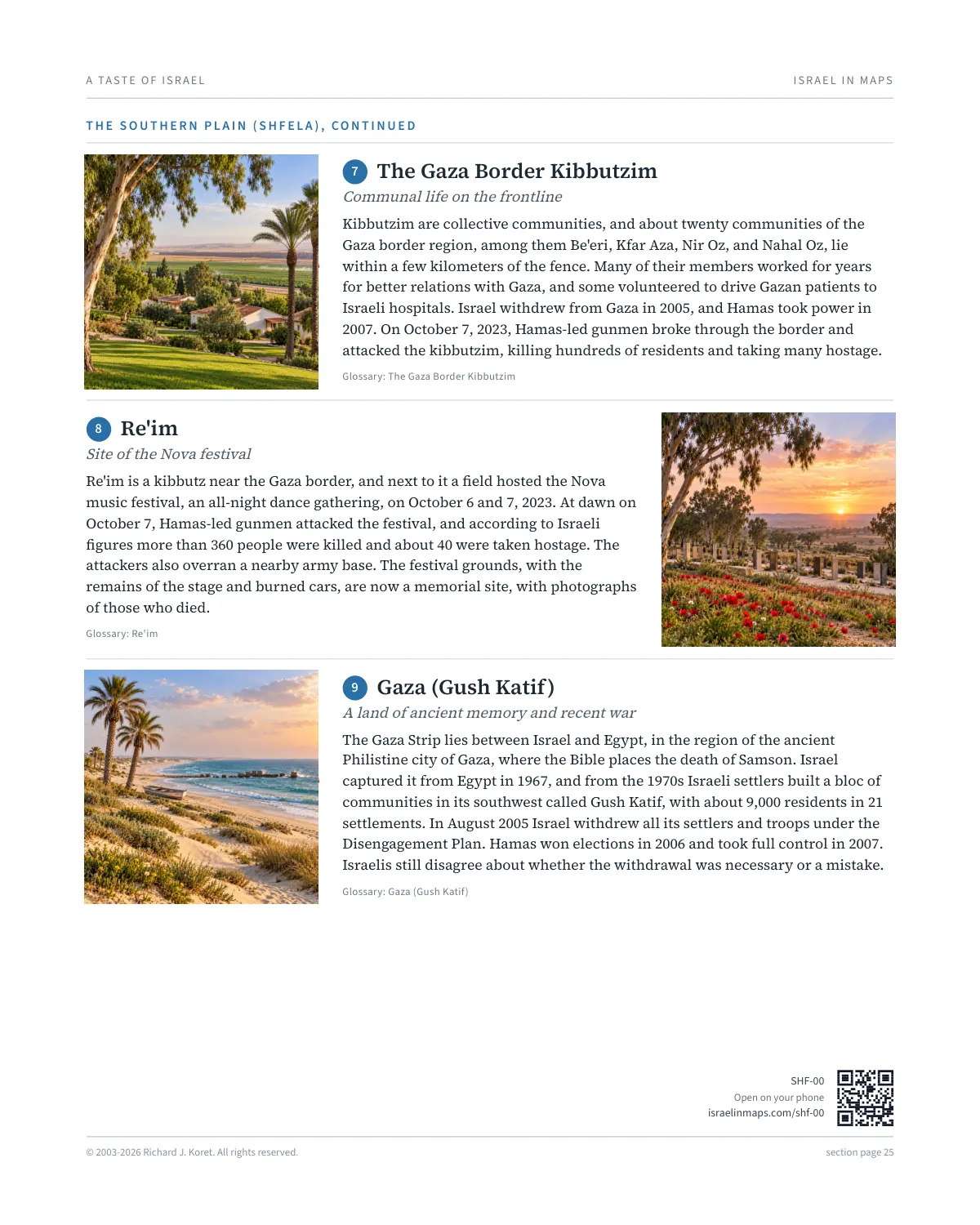
The Gaza Border Kibbutzim
Communal life on the frontline
Kibbutzim are collective communities, and about twenty communities of the Gaza border region, among them Be'eri, Kfar Aza, Nir Oz, and Nahal Oz, lie within a few kilometers of the fence. Many of their members worked for years for better relations with Gaza, and some volunteered to drive Gazan patients to Israeli hospitals. Israel withdrew from Gaza in 2005, and Hamas took power in 2007. On October 7, 2023, Hamas-led gunmen broke through the border and attacked the kibbutzim, killing hundreds of residents and taking many hostage.
Glossary: The Gaza Border Kibbutzim
Re'im
Site of the Nova festival
Re'im is a kibbutz near the Gaza border, and next to it a field hosted the Nova music festival, an all-night dance gathering, on October 6 and 7, 2023. At dawn on October 7, Hamas-led gunmen attacked the festival, and according to Israeli figures more than 360 people were killed and about 40 were taken hostage. The attackers also overran a nearby army base. The festival grounds, with the remains of the stage and burned cars, are now a memorial site, with photographs of those who died.
Glossary: Re'im
Gaza (Gush Katif)
A land of ancient memory and recent war
The Gaza Strip lies between Israel and Egypt, in the region of the ancient Philistine city of Gaza, where the Bible places the death of Samson. Israel captured it from Egypt in 1967, and from the 1970s Israeli settlers built a bloc of communities in its southwest called Gush Katif, with about 9,000 residents in 21 settlements. In August 2005 Israel withdrew all its settlers and troops under the Disengagement Plan. Hamas won elections in 2006 and took full control in 2007. Israelis still disagree about whether the withdrawal was necessary or a mistake.
Glossary: Gaza (Gush Katif)
section page 25
SHF00 Open on your phone $.- ’)*2’ % *(„.#!›